Tine Jensen
AmCham International Leadership Series
Share on facebook
Share on twitter
Share on linkedin
Having previously worked in Barcelona while commuting from where she lived with her family in Dubai, Tine Jensen’s active lifestyle was a useful commodity to have in 2018 – the year Discovery’s Norwegian CEO guided the organization through their first year as the official broadcaster for both the Winter Olympics and the Norwegian top tier football league while simultaneously leading the company through drastic changes in a fiercely competitive market.
Tine sat down with AmCham to discuss the art of global leadership in an industry being revolutionized by the advent of digital platforms, highlighting the importance of being proactive and seeking new challenges along the way.
Where did you start? Can you give us a brief description of your path to where you are now?
I am born and raised in Bodø in Norway. My parents were both teachers and taught me the value of team sports, engagement, and solidarity. Generally, I was very active in sports and activities growing up. Later, I moved to Trondheim to study. I was originally planning to study business and administration, but I quickly discovered that I would rather do strategy, marketing, and organization.
Upon completing my degree, I was going to become a consultant – because that was what everyone with that degree did back then, but instead, after encouragement from one of my professors, I started working with broadcasting for the TV-distributor Canal Digital Cable.
Here, I was tremendously lucky with my first leader, which is much of the reason why I stayed in the field of media and broadcasting. Plus, it was a fun time to work with TV. Cable TV was going to be professionalized and digitalized through the internet, and I got to experience that exciting journey for the industry firsthand.
Subsequently, having briefly tested the dot com enthusiasm — an enthusiasm that ended equally as briefly — I stared working for MTG, which owns Viasat, getting my first real leader role with P&L responsibility.
Then, my husband and I, with our two kids, decided to move to Asia. I had always wanted to work abroad, and the girls were still only about one and four years old, so we made it work. I applied for a study leave from work and opted for an MBA in Singapore, despite living in Kuala Lumpur where my husband was stationed. Which means I was commuting – staying five weeks at home and three weeks in Singapore.
One year on, my husband was transferred to Thailand, which meant an extensively longer commute for me, but it was still a great experience although somewhat challenging at times with young kids at home.
Upon completing my degree, I was offered a new job at MTG in Norway and we returned home. I eventually moved to Schibsted to experience other roles and areas within the media business. At Schibsted, they asked if I could be their expert on pricing and monetization, and I thought, “Sure, I can be a subject matter expert. Why not?” It was extremely educational to work in a company that focused on both newspapers and online classifieds in a period of intense digital transformation.
After two winters at home, however, the family had had enough, and we decided to move to Dubai. My husband worked for a mobile operator there at that time, so I ended up commuting from Dubai to the Barcelona Schibsted office every other week. I loved working abroad, and I think it is terribly important to have that experience if you want to become a leader.
Abruptly, however, Discovery turned up with an offer. In the small Norwegian sector, the most exciting positions are few and far between, so the opportunity to become a combined CFO/COO with such a successful Norwegian broadcaster that is also part of a large, international broadcasting company was a no-brainer. That was three years ago, and I have since been promoted to lead Discovery in Norway.
What are the important decisions you make as a leader of your organization and how do they impact its global presence? Do you have any recent examples to share?
I mean, Norway and the Nordics are big markets in broadcasting. If something big happens here, it directly affects Discovery’s stock in the US. Furthermore, being in an industry currently under extensive digital disruption, the most important decisions I make are related to digital strategies and perpetual renewal, in addition to our abilities to adapt to new business models.
In our industry, time is our worst enemy. Both in terms of disruption from Netflix, HBO, Amazon Prime, and so on, but also related to the consumers. We are battling to gain the attention of consumers every day, which means we cannot simply just optimize our products, but we must be innovative and able to explore new business opportunities quickly when they arise.
Keeping that in mind, Netflix and their equivalents have revolutionized the digital customer experience, but where they only provide digital content, we must continue to spearhead the traditional, linear TV experience, while simultaneously competing with their technology on digital platforms.
Hence, my most important decisions relate to ensuring that we can offer the best of both worlds. To achieve that, we cannot rely upon a five-year strategy anymore. The industry moves too quickly for that, which is why it is more essential than ever to communicate to the organization and the team in order to get them to not only understand the transformation process, but participate in it — and that is getting increasingly complex.
It is like American football — you know you need to get the ball to the endzone, but the tactics that get you there change continuously.
In an international organization, how do you build team morale and maintain creativity?
We have been through significant changes at Discovery in the past few years and have consequently changed the way we work. Everyone needs to master working across linear and digital, and through such vast changes in personnel, we have spent a substantial amount of time communicating our values, ambitions, and culture.
Through such processes, I believe the most important aspect I can contribute is to communicate the “why.” Why are we doing this? A leader will never get people to move in the same direction unless he or she manages to appeal to both the heart and mind of their colleagues, in addition to empowering them to be creative along the way.
This is particularly important when the organization is going through vast and drastic changes. For me, that means being open about both what we know and what we do not know, while laying the foundation that enables the organization to do what they do best – producing excellent content.
Would you use the same leadership style in a different organization? In a different country? How important is it to tailor your leadership style to your team and environment?
The core style would be the same — ensuring that I am there for the people around me and encouraging them to perform to the best of their abilities. Other aspects of my leadership style, however, would be adapted. The challenge is how to be authentic in light of the cultural context.
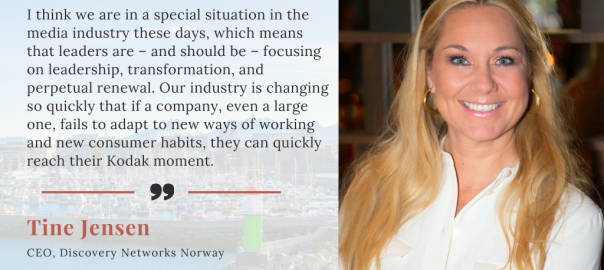
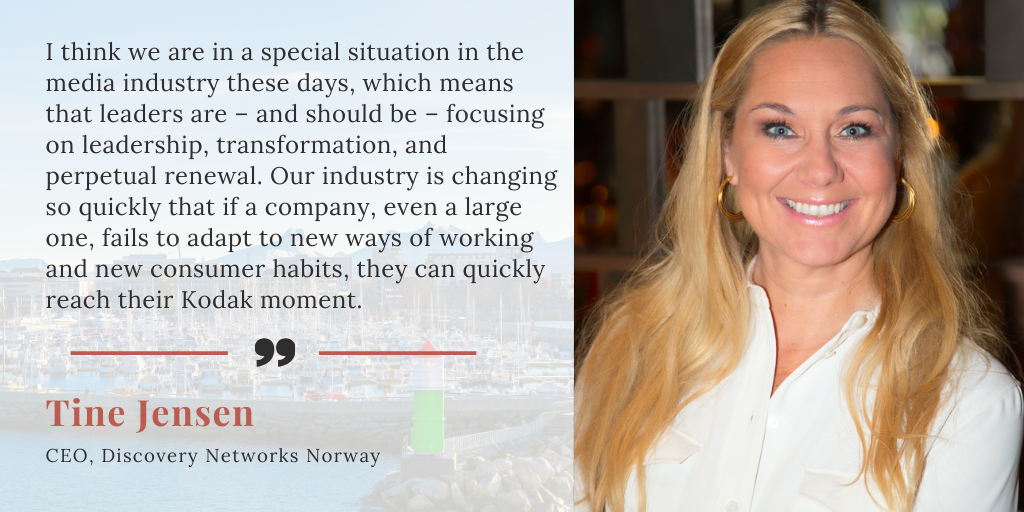
In terms of the organization, I think we are in a special situation in the media industry these days, which means that leaders are – and should be – focusing on leadership, transformation, and perpetual renewal. Our industry is changing so quickly that if a company, even a large one, fails to adapt to new ways of working and new consumer habits, they can quickly reach their Kodak moment.
Where do new ideas and exciting proposals come from in your organization? Has your international experience helped you ‘think outside the box’ in your organization?
I am lucky to be working in a very creative industry. We are in the entertainment business after all. There are plenty of ideas from the organization locally as well as globally. Basically, a lack of ideas is not the problem, but finding the time to prioritize all of them is, which is why we must be selective. My job in this process is to ensure that ideas are flowing freely across departments internally. I dislike the thought of missing out on a great idea due to internal miscommunication.
What do you believe are shared traits among good leaders? Are than any common mistakes you notice leaders making? What is unique about being a leader in Norway compared to leading an organization in another country?
Most leaders generally have a strong sense of curiosity and drive behind them. I also think it is important to believe in yourself and the choices you make to ensure that you are authentic in your endeavors. I think if leaders fail to live their own ideals, one can quickly start losing the people. They too need to believe that leaders care.
Furthermore, I think it is important to be humble and look at oneself from the outside to understand how one might be perceived. Where leaders have previously failed – myself included – is when we fail to listen. Listen to the people in your leadership team and to the people in your organization.
If your job was a sport, which sport would it be?
I like the comparison to American football that I mentioned earlier. A sport with strategies, tactics, and a high pace, but where teamwork is essential to get into the endzone. Without a good team and collaboration, you can have the best strategies in the world, but it would make no difference.

How do you continue growing and developing as a leader?
It is rooted in my nature to seek challenges and be proactive. I prefer learning by doing, and I naturally seek out seeking challenges and tasks that I have not done before. It is difficult at times, but at the end of the day, I tell myself, “What is the worst that can happen?” Of course, it might have been more comfortable to not have sought out these new challenges, but it is in my nature and is a big part of why I have made it to where I am today.
When it comes to recent developments at Discovery, what are you are excited to talk about?
We have had a lot to be proud of recently. We did fantastically well last year with the Winter Olympics. Seeing the results of something we have worked very hard on for so long truly paying off is a great boost. It simply does not get much bigger than the Winter Olympics in Norway in terms of sports broadcasting! Additionally, expectations were extremely high as TV2 and NRK had done such great job with it for many years.
Furthermore, the way we combined the linear TV experience with digital players and streaming, in addition to how we managed to collaborate with third parties, was also great to see.
You get the podium at Stortinget for 5 minutes, what topic(s) do you address and why?
The professional Tine would address the importance of maintaining a strong media diversity in Norway. Media diversity is much more than news and online papers. The Norwegian language is important, and that is highlighted through quality Norwegian content, which we are proud to deliver.
As a private person, I would address elderly care in Norway. It is beyond me that even though we have so much wealth and welfare, we are still unable to deliver better elderly care for the people that built this country. When you look at future of healthcare challenges as well, with the Norwegian population expecting to become increasingly older, elderly care should be improved before more people reach that stage.
Where do you see yourself and your company five years from now?
If I am still relevant to the company and the company is relevant to me, I hope I am still at Discovery. As far as Discovery is concerned, we are still as relevant to the Norwegian people and the market as we are today, if not more. We are one of the leading digital content providers, producing quality Norwegian and sports content on Norwegian terms. That is our core business.
If you could give your 20-year-old self some advice, what would it be?
I would give the same advice to any 20-year-old. Work hard to be yourself. It is so easy to try to be someone else. Trust yourself and your values.
What do you see in the next generation of leaders aspiring to run an international organization? Do you have any advice for them?
Be curious! Go out to travel and study abroad – way too few are doing that. Even though you are planning for adult life in Norway, you should still get some global experience by living abroad.
Additionally, be prepared to work hard and smart. There are no shortcuts to your dream job, but that does not mean that you should keep running at the same wall repeatedly. Be smart – there is always more than one solution to a challenge!