All posts by admin

Investments in Nordic data centres set to double by 2025, new report reveals

A study commissioned by the Nordic Council of Ministers projects sharp growth for the Nordic data centre market until 2025 – with expected annual construction investments in the order of EUR 2-4.3 billion.

“The Nordics have the potential to evolve as a truly global data hub, connecting Europe to North America and Asia,” says Philip Low, independent analyst and Chairman of BroadGroup, commenting on a new report published by the Nordic Council of Ministers’, “Data Centre Opportunities in the Nordics – An Analysis of the Competitive Advantages”.

The study, which was carried out by COWI Group, compares the attractiveness of the Nordic region to the so-called FLAP-D region (Frankfurt, London, Amsterdam, Paris and Dublin), against the background of accelerating data volumes worldwide and the challenge of tackling sustainable growth of cloud, streaming and computing services.

According to the report’s findings, the Nordics are likely to gain market share thanks to five key advantages: abundant renewable energy, reliable power supply, low energy prices, political stability and faster time-to-market primarily due to ease of doing business.

The Nordic data centre construction market is estimated to attract annual investments of EUR 2-4.3 billion by 2025. This corresponds to an installed annual capacity of 280-580 MW per year. The Nordic region is well connected to the UK, continental Europe, and the US, and major fibre optic installations linking the Nordics to North America and Asia are in the planning stages.

“Cloud and hyperscale companies such as Facebook, Google, Amazon Web Services and Apple have made major investments in Nordic data centres recently. Our report shows that the Nordics meet all key criteria for site selection, ranging from reliable, renewable energy to world class fibre optic infrastructure. This presents a powerful proposition for corporate investment in existing and new facilities” says Jakob Dybdal Christensen, Chief Market Manager, COWI, and one of report’s lead authors.

In addition to electricity production that is two thirds renewable across the region, from sources such as biomass, hydropower, geothermal and wind power, the report underscores the competitive value of advancing cross-border collaboration in the Nordics.

Philip Low, Chairman of BroadGroup, adds: “Contrary to popular belief, the Nordic region is not just well connected and integrated to continental Europe, the UK and the U.S, but increasingly to Asia. The Nordics are speeding ahead with intercontinental installations along the Polar fibre route. This means we may be seeing the quickest routes to moving traffic via the Nordic countries in the near future.”

The report “Data Centre Opportunities in the Nordics – An Analysis of the Competitive Advantages”, published by the Nordic Council of Ministers, will be available here

Jotun: Robots ahead for sustainable shipping

Underwater robotic cleaning and inspection is set to play a bigger role as owners and operators strive for fuel-efficient, sustainable operations.

Faced with new environmental regulations and market pressures, owners and operators continue to look for innovative ways to reduce operational costs and emissions.

Some of the common technical measures they are already using include improved ship/hull design to reduce drag, and more efficient propulsion systems. Operational methods include the use of technology to better manage vessel weight, reducing speed and improved weather routing to maximise fuel efficiency.

Choosing the right hull coating is another way that operators can reduce fuel costs and emissions throughout the drydocking interval. Fuel is the biggest cost driver and by avoiding biofouling and reducing drag, ships use less fuel and produce fewer emissions.

Adverse affects
Typical savings are difficult to quantify as operational efficiency in all vessels is affected by a number of variables, though high resolution data collected according to the ISO 19030 standard provides a good picture of long term trends. Regardless of the antifouling coating applied, most ships will suffer a degree of fouling between drydockings that can adversely affect their performance – and the owner’s bottom line.

As reported by ShipInsight, operators of fouled ships have a number of choices open to them including having the hull cleaned by a specialist contractor. The time to the next drydocking and the extra fuel being consumed must be weighed against the cost of cleaning the hull and for ships with a limited lifespan coating, the possibility of damaging what coating remains is also a factor to be considered.

Ships that have been hard coated are far less likely to suffer damage from cleaning operations and leading coating manufacturers recommend that cleaning is undertaken regularly if the full benefit of such premium coatings is to be enjoyed. Cleaning can be done by almost any diving contractor with appropriate equipment but there are specialists in the field.

ROV technology
The tools best suited to cleaning hulls are often developed by the specialist contractors and sometimes marketed to independent contractors. Most use manual operated tools but there are a number of alternatives that use ROV (remotely operated vehicle) technology.

CleanROV, Mini-Pamper and HullWiper ROV are just a few of the systems that are already on the market. Fleet Cleaner also uses remotely controlled robots to remove fouling while the ship is loading and unloading. Since the first in-water trials in 2015, the service has been rolled out to all Dutch ports reflecting its increasing popularity with ship operators.

Deepak Thacheril, senior engineer in Jotun’s technical support team, who has been working with underwater robotics in Korea, comments: “We have used ROV’s to monitor the development of hull fouling over several years. Based on our experience, we see that owners and operators are becoming increasingly aware of the benefits of clean hulls. It is important for them not only because of cost savings but also in terms of meeting new environmental regulations.”

Limitations
He continues, “The traditional method of inspection and cleaning of hulls (using divers) can be challenging at times due to specialised diver availability and stringent safety procedures. There are also limitations as regards regular inspections and niche areas to be inspected or cleaned. One of the main benefits of using ROV technologies is that it lessens the reliance on divers. This makes it much easier to get approvals for surveys, and, indeed, helps to improve the quality of the surveys. It is also a safer and more cost-effective solution in the long-term.”

There are other benefits according to Thacheril. “Paint manufacturers can monitor the underwater hull and paint condition directly, rather than using an intermediary (diver). Based on data collected, the paint manufacturers can then develop products and solutions that are better matched to the vessel and the expected conditions.

“Here in Korea, the major paint manufacturers are using robotic solutions mainly for surveys. Robots for underwater hull cleaning are still being tested and their commercial application will depend on the test results. I believe that with improved technology, processes and operational capabilities, robotic hull cleaning could, over time, replace the current manual methods,” adds Thacheril.

While the coating technology is in place, more work is needed to develop economical, fast, and widely available hull cleansing services to combat fouling. Robotics is the key to this, said DNV GL’s Volker Bertram, at the Hull Performance & Insight Conference recently held in the UK.

Economic and ecological necessity
“Antifouling is both an economic and ecological necessity, and new ideas and technologies are constantly emerging in this field. As owners and operators work to address new environmental regulations and market pressures, we are likely to see more high-performance coatings in use, with robotised application and mild, frequent cleansing.  Also, it is not unreasonable to assume that operators will require all coating and cleansing product and method choices to be made based on robust performance monitoring to meet stakeholder requirements,” said Bertram.

Clearly, the economical and environmental impact of foulings, combined with the changing regulatory and market conditions in the industry, are adding to the pressure for more innovation and improvement. This also applies to hull cleaning methods and industry sources are predicting that underwater robotic cleaning is set to play a bigger role to combat fouling issues.

Embracing new technologies
The rapidly progressing digitalisation is also having an impact as owners and operators embrace new technologies. According to recent research conducted by Lloyd List Intelligence, two-thirds of vessels now use advanced sensor technology and digitalisation systems onboard. The driver for this, according to those surveyed, is the desire to improve operating efficiency.

This development also benefits coating manufacturers who use the vast amount of data, artificial intelligence and robotic technology to show customers the potential performance benefits of fouling control coatings based on accurate, transparent information. This, in turn, helps customers to make informed decisions from both an economic and environmental perspective.

Certainly, for the forward-thinking companies that are receptive to new technologies there are opportunities to use robotics and digitalisation to achieve fuel-savings and to meet the impending environmental challenges.

Jotun provides paints and coatings to 12 of the top 20 tallest buildings by 2020

Jotun, leading global supplier of paints and coatings, has provided its products and services to 12 of the top 20 tallest buildings by 2020.

Jotun, who will be exhibiting at Council on Tall Buildings and Urban Habitat (CTBUH) Middle East conference this week, will be showcasing a range of its single source solutions, including its range of Green Building Solutions (GBS) – the easiest way to design, specify, beautify and protect buildings globally with green building products, with products from the range in use in some of these projects.

The CTBUH conference runs from October 20-25 in Dubai and Abu Dhabi, and is a key date in the calendar of many in the construction and architecture sectors, as the world’s leading resource for professionals focused on the inception, design, construction, and operation of tall buildings and future cities, with Jotun being a gold sponsor of the event.

Jotun’s Green Building Solutions provides paints and coatings across a full range of building needs – with specification support for the planning stage and global availability for construction stage – including architectural powder coatings; anti-carbonation coatings for concrete; decorative paints; floor coatings; intumescent coatings for cellulosic fire protection and protective coatings.

As well as this, Jotun offers an online green building guide, making the specification process as easy as possible. This includes an easily accessible overview of all the green building products and guide specifications, along with all the needed documentation (including Environmental Product Declarations (EPDs) where available).

GBS provides a single global source for customers looking for an easy way to increase points for green building standards, including Leadership in Energy and Environmental Design (LEED) and Building Research Establishment Environmental Assessment Method (BREEAM). The GBS products work together to make it simple to attain LEED certification, aided by the vast number of EPDs that Jotun provides for its Green Building Solutions.

Henriette Eggen, Jotun’s global marketing manager, infrastructure, said: “We are delighted to be exhibiting our Green Building Solutions and the online Green Building Guide to those attending the CTBUH Middle East conference this year, and to the growing green building industry.

We have worked hard to ensure we are able to provide an extensive range of green building products and the most efficient type of Environmental Protection Declarations (EPDs) for our customers worldwide: third-party verified Product-specific Type III EPDs. This ensures our customers get the most points value from their paints and coatings possible, all from one supplier.

We are proud to be a trusted partner and source of paints and coatings in the global construction industry, whether it be residential or public, industrial or civic buildings. We look forward to showcasing our range of GBS to all at CTBUH Middle East conference this year.”

Prime Minister Solberg spoke to the marine experts on Thanksgiving

Prime Minister Erna Solberg addressed 160 of the world’s leading ocean experts.

The Institute of Marine Research (IMR) is hosting the conference “Science for Ocean Actions”, which was launched by the Norwegian Prime Minister Erna Solberg at the G7 summit in the summer. The conference brings together 160 ocean experts from 49 different countries. For two days, they will discuss the most urgent priorities in order to keep our oceans pure and productive for the future. At the end of the conference they will make specific recommendations to Prime Minister Solberg’s High-level Panel on Building a Sustainable Ocean Economy, which is made up of twelve heads of government and the UN’s Special Envoy for the Ocean.

– I cannot think of a better way to use science than to make the oceans sustainable”, said Sissel Rogne, Managing Director of the IMR when she opened the conference earlier today.

Event Summary: Thanksgiving Charity Dinner 2018

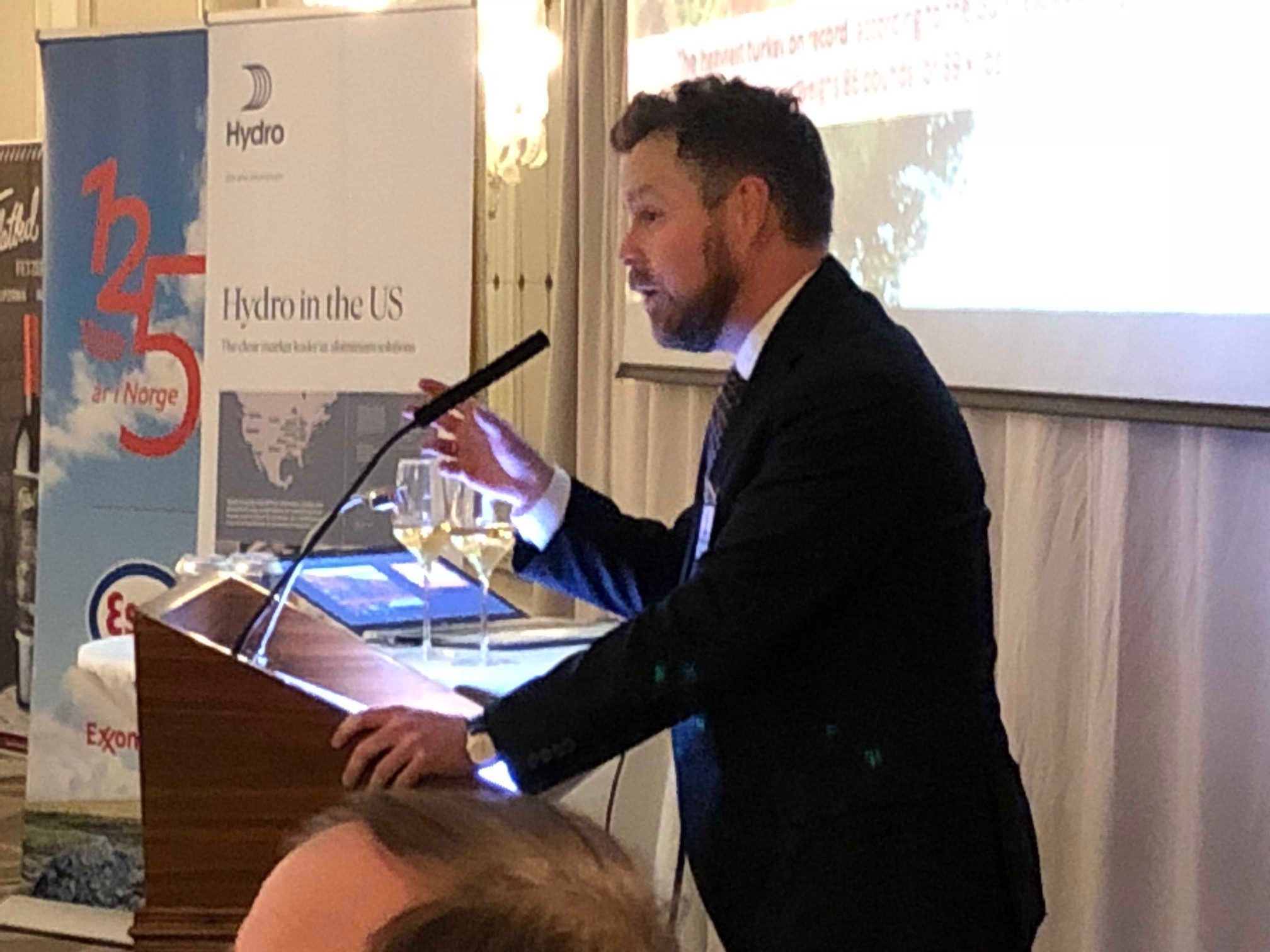
It was an evening of thanks, turkey, high spirits and charity as AmCham hosted our traditional Thanksgiving Dinner at Grand Hotel, where guests helped raise a record NOK 91.000 for this year’s charity partner – The Ocean Cleanup.

Thanksgiving Charity Dinner 2018

Sponsored by ExxonMobil, Biogen and Hydro, the evening included an authentic American Thanksgiving meal, prepared by the renowned Grand kitchen in collaboration with Stavanger’s legendary Chef Craig Whitson. Whole stuffed turkeys, glazed ham, sweet potatoes, and assorted American pies were accompanied by Fetzer Flatbed Red Blend and Bonterra Chardonnay from California.

Working Together

In his Thanksgiving address, Minister of Trade & Industry, Torbjørn Røe Isaksen, touched upon some of the key reasons why both Norway and the US can be grateful for an excellent relationship.

Thanksgiving Charity Dinner 2018

Trade Minister, Torbjørn Røe Isaksen (Photo: Nancy Bundt)

“We are friends, trading partners and close allies – working together to create jobs and promote common values. We have just conducted Trident Juncture – the largest NATO exercise for many years – and proven our ability to operate together and stand up for each other.”

“According to a report presented last year, Norwegian companies and investments are supporting nearly half a million jobs in the US. Equally, from ExxonMobil and ConocoPhillips to Accenture, Alcoa, Coca-Cola, Cargill, Bristow Norway, Mondelez, McDonald’s and 650 others, the US is a major contributor to jobs, welfare and happiness here,” the Minister said.

A Culture of Sharing

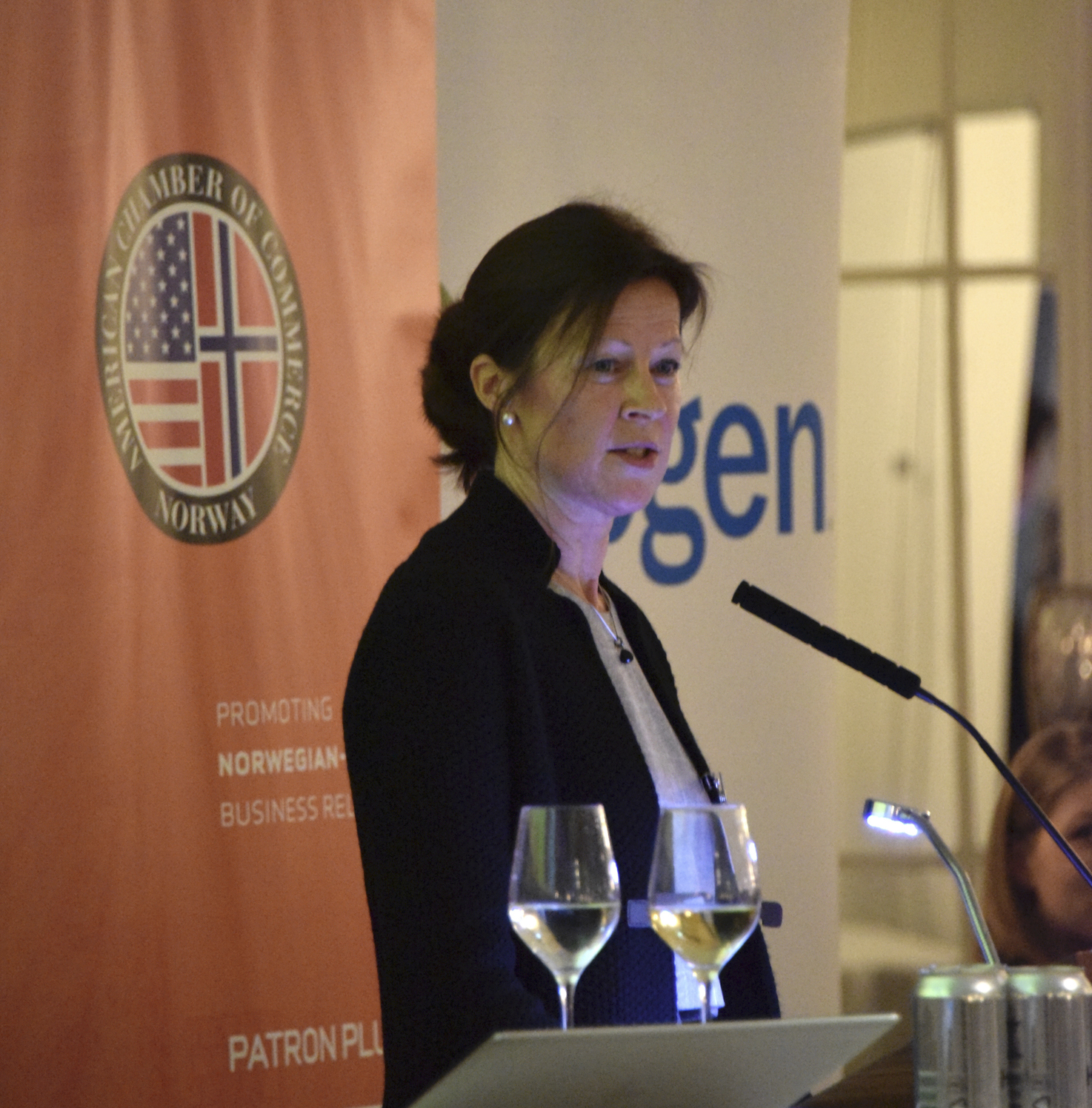
Fittingly headquartered in Massachusetts — where Thanksgiving is rooted — dinner partner Biogen is a neuroscience pioneer, with an ambition to cure Alzheimer’s disease. Speaking just after the Minister, Country Director Kristin Nyberg noted the importance of good health and collaboration during her dinner address.

“An interesting topic in that respect is looking into how the US and Norway can cooperate in the best way to find success in health and innovation. As an inspiration, we can look to the unique collaborative environment in Boston.”

Thanksgiving Charity Dinner 2018

Kristin Nyberg, Biogen (Photo: Nancy Bundt)

“There, our headquarters is on the same street as MIT, Harvard and several biotech companies. The researchers there have breakfast with students, lunch with CEOs and dinner with investors.”

“That is the key to success for all parties – and we should adapt that as quickly as we can here; a triangle of academia, healthcare professionals and investors.”

“Let’s work for such an environment to thrive within the new Life Science building at the University of Oslo, and we will make Norway an even better place to do business in the future,” Nyberg said.

Charity Raffle & Auction

Following dinner and Thanksgiving reflections by US Ambassador Kenneth J. Braithwaite, guests gathered for a lively charity raffle and auction, stocked with spectacular prizes donated by AmCham member companies.

Among the many winners, guests took home a large aluminum print by Pål Laukli courtesy of Featuring Spaces, an Icelandair gift certificate, an exclusive 1984 Prince photograph by Nancy Bundt, a Tesla-weekend and an all-inclusive VIP stay at Grand Hotel.

Thanksgiving Charity Dinner 2018

(Photo: Nancy Bundt)

With NOK 91.000 generated for further development of The Ocean Cleanup technologies, AmCham extends heartfelt thanks to all who so generously contributed!

Skip to PDF content

Det hvite hus bommet med rapport om nordisk levestandard

Norge var utelatt da Det hvite hus for noen uker siden publiserte en rapport om levestandarden i USA sammenliknet med Norden.

Nordic country living standards are still at least 15 percent lower than in the U.S.»
Det hvite hus – 23. oktober 2018
Faktisk helt feil.

Rett før mellomvalget publiserte Det hvite hus en rapport med tittel «The Opportunity Costs of Socialism». De økonomiske rådgiverne har utelatt Norge som en del av Norden i påstanden om 15 prosent lavere levestandard.

Fire nordiske land kommer bedre ut enn USA på FNs indeks over inntekt, levealder og utdanning. På FNs indeks over BNP per innbygger ligger Norden samlet fire prosent lavere enn USA. Det er dermed feil å si at Norden har «minst 15 prosent lavere levestandard enn USA».

Ingen av disse indeksene reflekterer verdien av gratis velferdstjenester som helse, barnehage, utdanning og trygd. Medregnet slike velferdstjenester, ville USA kommet enda dårligere ut.

Vennligst se hele artikkelen på NRK her.

Event Summary: AmCham Sustainability Forum November 2018

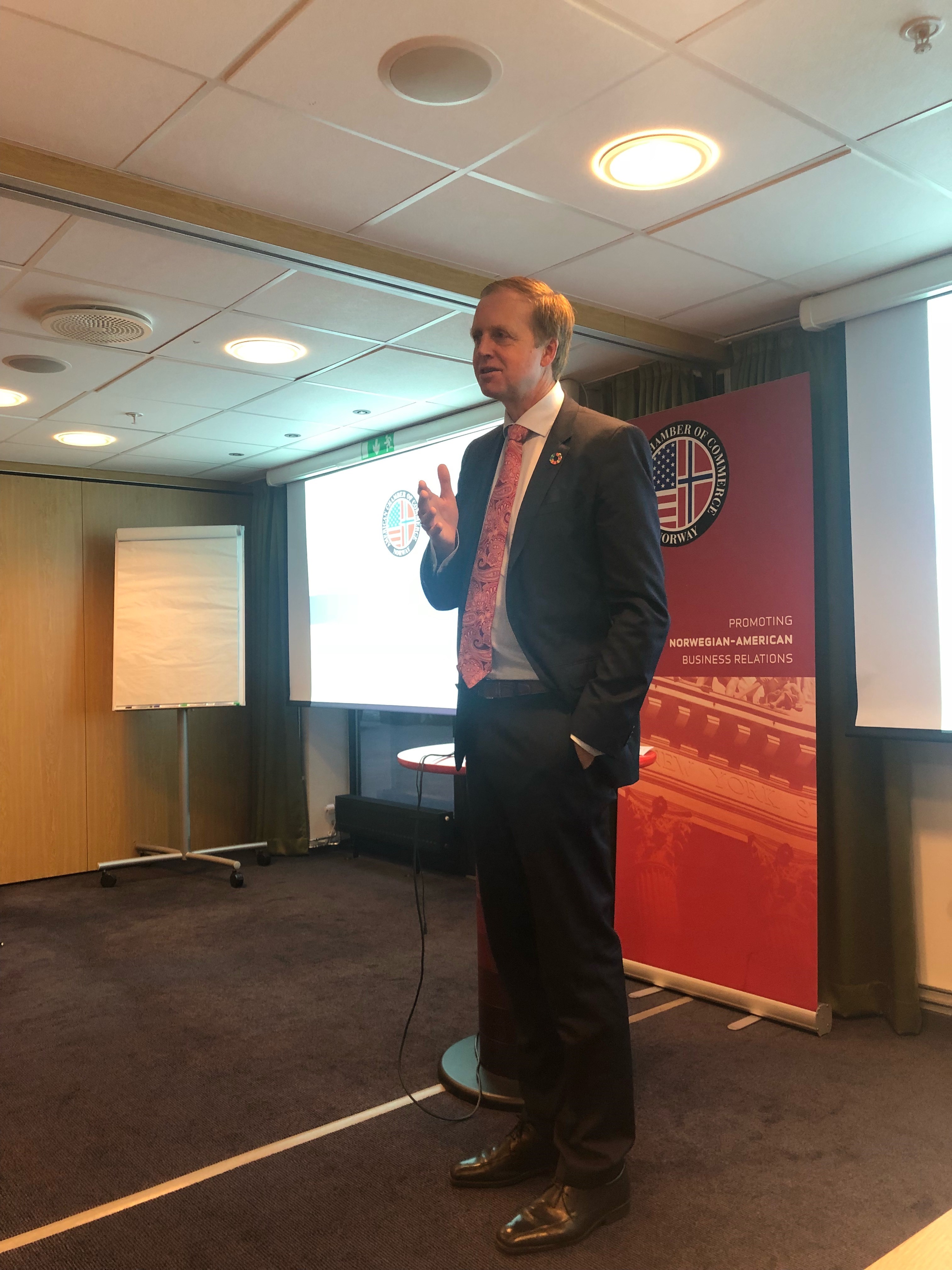
“The carrot works better than the stick when motivating companies to develop a pro-sustainability agenda,” guest speaker Jens Frølich Holte from the Ministry of Foreign Affairs told participants during AmCham’s recent Sustainability Forum.

Sustainability Forum November

Highlighting the importance of collaboration with the private sector, State Secretary Frølich Holte shared insights into the Norwegian Government’s efforts toward reaching the UN’s Sustainable Development Goals (SDGs) with senior representatives from AmCham members Coca-Cola, DNV GL, InterimLeder, Fast Solutions, Gelato, McDonald’s, Umoe Restaurants, Radisson and Roche.

Corporate Sustainability Defined

Following upon the success of our inaugural meeting, AmCham’s Sustainability Forum brings invited cross-industry member company representatives together to openly discuss opportunities and challenges, share best practices and determine how AmCham members can best play a role in the Norwegian sustainability agenda going forward.

For clarity in future Forum initiatives, participants agreed in principle that corporate sustainability is the systematic, long-term management and coordination of environmental, social and economic principles to ensure responsible, ethical and lasting business success.

An Agenda of Opportunities

Bjørn Haugland, Chief Sustainability Officer, presented DNV GL’s holistic approach to sustainability efforts within his organization, which works within 25 different industries in more than 100 countries.

Sustainability Forum November

“Sustainability is all about culture, which needs to be successfully imbedded into the company. The term is not merely about environmental issues, but rather it encompasses a broader perspective of doing business, as represented by the UN’s 17 Sustainable Development Goals.”

“Running a sustainable company creates better opportunities while also serving your customers’ needs better, as there is a growing global demand from consumers for more sustainable business practices,” Haugland added.

The Government’s Development Goals

State Secretary Frølich Holte went on to explain that since the establishment of the Sustainable Development Goals, there has been a significant change in rhetoric regarding development aid.

“With international political support for SDG’s wavering, the private sector is now driving developments. Aid is being woven into company strategies with increased emphasis on voluntary partnerships,” he said.

A negotiated and universal agenda consensus – driven by 193 UN member states – is key to achieving the SDGs, and the State Secretary encouraged the private sector’s continued involvement in, and pioneering of, the sustainability agenda going forward.

AmCham’s Sustainability Forum was introduced earlier this year, with the next meeting scheduled for February 2019. Please contact us for interest in future forums.

Norske aktører signerer historisk erklæring for å bevare digital tillit

12. november møttes verdens ledere i Paris for å markere 100-års jubileet for slutten av første verdenskrig. Samtidig markertes starten på et nytt internasjonalt samarbeid. For første gang i historien går statsoverhoder, organisasjoner og næringsliv sammen for å styrke sikkerheten i det digitale rom. Målet er å bygge en felles front i møte med nye digitale trusler og sårbarheter.

Erklæringen heter the Paris Call for Trust & Security in Cyberspace. Ved å signere erklæringen forpliktes aktørene til å samarbeide og hjelpe hverandre for å møte trusler i det digitale samfunnet, og etterfølge de felles normene satt for å beskytte sivile, kritisk infrastruktur og verdensøkonomien.

Microsoft jobber daglig for å stoppe nettangrep og har signert erklæringen, men selskapet er ikke alene om det. Nylig har også Telenor ASA, IKT-Norge, Abelia, AmCham Norge og Business Peace Foundation signert the Paris Call for Trust & Security in Cyberspace.

– De digitale truslene er grenseløse, og de mest alvorlige cyberangrepene mot nasjonal kritisk infrastruktur i Norge utføres langt utenfor våre landegrenser. Dette oppropet er en start på veien mot et styrket internasjonalt samarbeid om digital sikkerhet, både for Telenor i Norge og for våre internasjonale virksomheter. Myndigheter kan møte cybertrusler alene like lite som de alene kan bekjempe klimautfordringene. Når digitale sårbarheter blir felles, trengs samarbeid som involverer virksomheter, sivilsamfunn og myndigheter sier Hanne Tangen Nilsen, sikkerhetsdirektør i Telenor Norge.

– Antall statlige angrep øker og setter demokratiet under press. Alle har et ansvar, inkludert oss teknologiselskaper. Myndighetene alene klarer ikke beskytte de sivile. Som utviklere av teknologi, operatører og eiere av digital infrastruktur må vi ta ansvar for vår egen og våre kunders sikkerhet, og effektivt håndtere cyberangrep. Milepælen ved dette internasjonale Paris Call initiativet er at alle aktørene nå sitter rundt samme bord, og er enige om noen felles prinsipper for å styrke tillit og sikkerheten i det digitale rom, sier Kristine Beitland, direktør for myndighetskontakt i Microsoft Norge.

Voldsom øking i cyberangrep verden over

I fjor ble rundt en milliard mennesker offer for cyberangrep eller nettkriminalitet. Hele 74 prosent av verdens selskaper forventer å bli hacket hvert år (kilde: isaca.org). Det økonomiske tapet av cyberkriminalitet er anslått å nå tre billioner dollar innen 2020. Selv om disse økonomiske tapene vokser, overskygges de av en ny og mer omfattende trussel som cyberangrep mot nasjoner og politiske institusjoner.

– Myndigheter verden over må bli flinkere til å invitere næringslivet inn. Vi må gi ros til franske myndigheter som nå endelig inviterer teknologiaktørene og næringslivet til bords. For utfordringene i det digitale rom er grenseoverskridende på tvers av land, bransjer, sektorer og virksomheter. Vi må gå sammen for å beskytte sivile i ett av verdens mest digitale land, og derfor støtter flere norske aktører initiativet. The Paris Call for Trust & Security in Cyberspace er for oss en milepæl i arbeidet for fred i det digitale rom, forteller Beitland.

Investerer massivt i sikkerhet

Microsoft investerer mer enn 8 milliarder norske kroner hvert åri sikkerhet. Selskapet har blant annet en egen avdeling, Digital Crimes Unit, og til sammen 3500 ingeniører som jobber med avansert analyse for å bekjempe og etterforske sikkerhetstrusler daglig.

– Vi er på 24 timer i døgnet året rundt, og har et unikt innblikk i trusselbildet med kapasitet til å handle. Vi deler det vi erfarer, også med norske myndigheter. For sikkerhet er et felles ansvar, og alle gode krefter må ikke bare finne hverandre – men tas i bruk, avslutter Beitland.

AmCham Norway Endorses the Paris Call for Trust & Security in Cyberspace

Cyberspace now plays a crucial role in every aspect of our lives. It is the shared responsibility of a wide variety of actors to improve trust, security and stability in cyberspace.

Paris Call

The American Chamber of Commerce in Norway (AmCham Norway) supports an open, secure, stable, accessible and peaceful cyberspace – which has become an integral component of life in all social, economic, cultural and political aspects.

Together with many States, private companies and civil society organizations, AmCham Norway therefore endorses today’s Paris Call for Trust & Security in Cyberspace to:

  • Increase prevention against and resilience to malicious online activity
  • Protect the accessibility and integrity of the Internet
  • Cooperate in order to prevent interference in electoral processes
  • Work together to combat intellectual property violations via the Internet
  • Prevent the proliferation of malicious online programs and techniques
  • Improve the security of digital products and services as well as everybody’s “cyber hygiene”
  • Clamp down on online mercenary activities and offensive action by non-state actors
  • Work together to strengthen the relevant international standards

Coming together to increase trust, security and stability in cyberspace, the first edition of the Paris Digital Week brings governments, industry and civil society organizations concerned with cyberspace stability closer together.

DNV GL launches first Battery Performance Scorecard to provide independent data to battery system buyers

DNV GL, the world’s largest resource of independent energy experts and certification body, has released its first annual Battery Performance Scorecard, to help equip energy storage product buyers with objective data to guide their purchase strategies. The Battery Performance Scorecard provides independent ranking and evaluation of battery vendors based on testing performed in DNV GL’s laboratories.

The release comes as increased electrification is beginning to disrupt everyday markets, including energy and transportation. As the influx of renewable energy continues fostering the flourishment of the energy storage market, storage technology is becoming crucial to enable the global energy transition. In its latest Energy Transition Outlook report, DNV GL forecasts a growth of around 50 TWh in installed battery capacity by 2050, specifically to cope with variable renewables. The report also predicts that by 2050, solar PV, onshore wind, hydropower and offshore wind will account for 80 percent of global electricity production, creating a growing need for flexible storage solution.

DNV GL’s 2018 Battery Performance Scorecard further accelerates the energy storage market by providing transparent data that’s easily verifiable with independent reviews. The scorecard eliminates current obstacles slowing down transactions and streamlines independent engineering reviews by making key data readily available for reference.

For the scorecard, DNV GL evaluated the battery types according to the following abuse factors:

  • Average state of charge (SOC): Indication of how much charge remains in a
  • Battery, assessing whether the average SOC condition is harmful or optimal for the battery performance
  • State of Charge (SOC) swing: Testing at different SOC windows determines where the battery performs best
  • C-rate: The power at which a system charges or discharges is directly proportional to the cell charge rate, or “C-rate”.
  • Temperature: A critical criteria for the battery’s lifetime

DNV GL’s Battery Performance Scorecard provides a stable roadmap to assist battery buyers in managing and operating specific battery technologies, while validating warranties and replacement cost estimates. By measuring performance against the previously listed abuse factors, the Battery Performance Scorecard allows buyers to match their use with the most appropriate technology.

Key findings from the first ever scorecard review include: 

  • The Li-ion Nickel Cobalt Manganese chemistry is the most commonly used battery, addressing 88% of all tested batteries.
  • 33% of tested batteries showed decreased throughput beyond the group average when cycled near the middle of the SOC band, 44% at the top, and 22% at the bottom.  Throughput quantifies the total energy discharged, which diminishes as a battery ages.
  • 22% of participants showed better throughput at elevated temperature, and 22% of participants showed their lowest throughput at elevated temperature. 33% of participants showed their lowest throughput at low temperatures

The Scorecard aims to fill a gap since the current level of battery lifetime data available to purchasers is highly varied and not always consistent. Additionally, not all batteries should be treated the same. Buyers need reliable and rigorous battery testing to determine what constitutes high battery performance, while still meeting the time pressures of project finance.

In the process of choosing a battery type for a storage project, developers or investors currently have to request information on each battery type from the manufacturers, which would be reviewed in an independent engineering report to verify the information. This process can take several months. This time is significantly reduced with the scorecard, as the data is available for reference DNV GL’s participant queue. Thus, it can significantly accelerate the Independent Engineering review.

“Having access to this data will reduce independent engineering review time from months to weeks, which is a major advantage that benefits all parties involved. When battery manufacturers participate with DNV GL in the Scorecard, we can connect buyers with suppliers while providing objective data for their project,” noted Rich Barnes, Executive Vice President DNV GL – Energy North America.

“DNV GL aims to accelerate the energy storage market with novel, data-driven services that push the completeness and accuracy of technical due diligence to the next level,” said Davion Hill, co-author of the Scorecard and DNV GL’s energy storage leader in the Americas. “We understand that the energy storage market will have unprecedented growth each year from now going forward, and our customers demand repeatable and reliable services to support their transactions. We have delivered on that demand with a service that not only gives them more certainty and comfort, but also helps the supply chain benchmark quality.”