All posts by admin

Bloomberg: NASA Says Metals Fraud Caused $700 Million Satellite Failure

A metals manufacturer faked test results and provided faulty materials to NASA, causing more than $700 million in losses and two failed satellite launch missions, according to an investigation by the U.S. space agency.

The fraud involved an Oregon company called Sapa Profiles Inc., which falsified thousands of certifications for aluminum parts over 19 years for hundreds of customers, including NASA.

News of the satellite failures comes a week after Norsk Hydro ASA, the current parent company of Sapa, agreed to pay $46 million to NASA, the Department of Defense and others to resolve criminal charges and civil claims related to the fraud, which took place from 1996 to 2015.

A spokesman for Norsk Hydro said the case has been settled. Last week, it said it has invested “significant time and resources to completely overhaul our quality and compliance organizations.”

Read entire article HERE.

Bloomberg: Norway’s Wealth Fund Surges $84 Billion in First Quarter

Norway’s $1 trillion wealth fund gained $84 billion in the first quarter, or $16,000 per citizen, after it took advantage of a market sell-off late last year to build its massive portfolio.

  • Return was 9.1 percent, or 738 billion kroner ($84 billion)
  • Stocks rose 12.2 percent, bonds 2.9 percent and real estate 1.7 percent
  • Fund held 69.2 percent in equities, 28 percent in bonds and 2.8 percent in real estate

The fund’s chief executive officer, Yngve Slyngstad, said it was an “exceptional” quarter with the third highest quarterly return on record and the highest ever in terms of kroner. He directed the fund to buy almost $30 billion in stocks in November through January to take advantage of a drop in prices and drive its holdings to near the 70 percent limit.

“The most significant change in the first quarter was probably the new signals from the Federal Reserve, which to a large degree drove the market,” he said in an interview after a press briefing in Oslo. “There have been very different views on macroeconomic developments from different actors.”

Read entire article HERE.

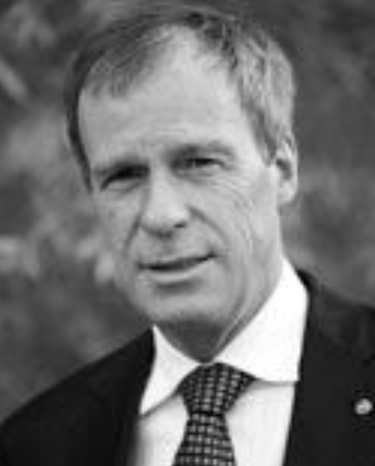
International Leadership Interview: Knut Revling, Co-Founder & Managing Partner, Management Alignment Partners (MAP)

Knut Revling

AmCham International Leadership Series

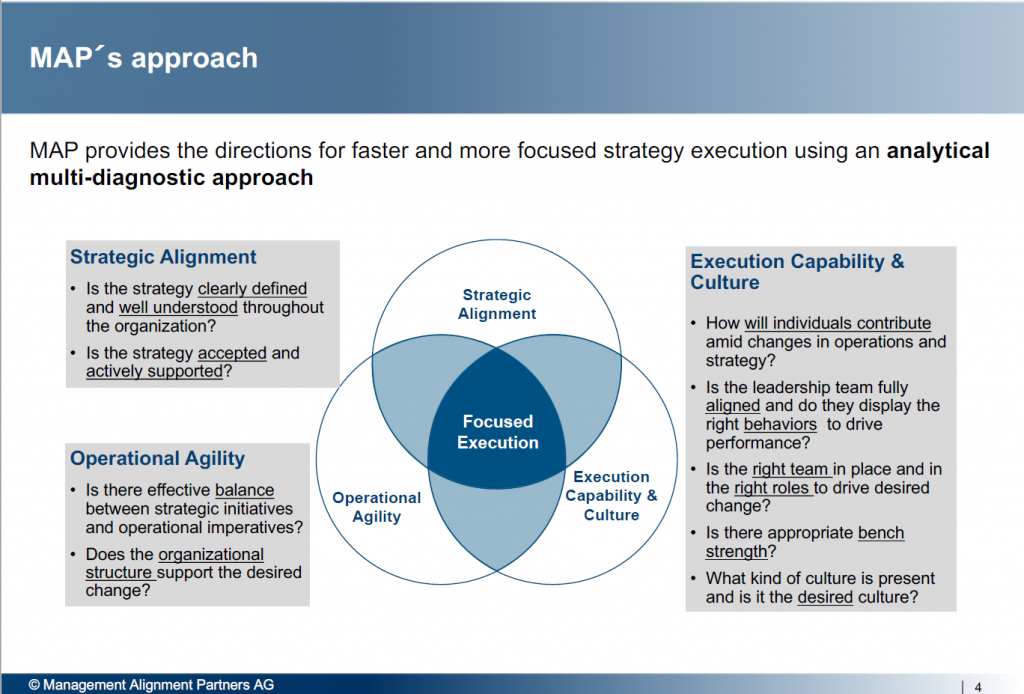
Knut Revling co-founded Management Alignment Partners (MAP) with Derek Leebaert in 2003-2004 to address a gap in the consulting industry – a lack of firms that focus on strategic alignment and strategy implementation.

MAP has since expanded to twenty-one cities around the world, building an enviable global client base in the process.  Along the way, Revling gained extensive insight into what it takes to advise and lead in dynamic international settings, insight he shared with AmCham in the latest edition of our International Leadership Interview Series.

Where did you start? Give us a brief description of your path to where you are now, particularly in terms of international experience.

We started Management Alignment Partners some fifteen years ago. We began by looking at the international marketplace for consulting and trying to find gaps in that marketplace.

At that time, I had already been working twenty years in the consulting business and knew I couldn’t just start another copy of other management consulting firms. If you’re doing the exact same thing as someone else, then you’re already redundant.

In sum, if you want to start something new, you have to be special. You have to be different.

So, what we did is we looked at the major consulting companies in the strategic area, companies like McKinsey, Boston Consulting, and Bain. They’re all over the world and they do a great job. And then we looked at executive search companies like Spencer Stuart, Russel Reynolds, and Korn Ferry, and we saw that they were doing a great job operating globally as well.

By studying these industries from both sides very carefully, we found out that there is nothing in between them – no firms in between strategy and executive search.

Therefore, we did something that is fundamentally different than strategy formulation. We focused on the implementation of strategy. The alignment of the strategies you get from a management consulting firm like Bain with the executives you’ve hired from working with a company like Korn Ferry.

So, that was how we started, and why we originally called the company Management Assessment Partners. The problem with assessment though, is that the word is quite broad – it could mean anything, really.

That led to some discussion over the years between the American and German partners over naming the company assessment or alignment, and it eventually became a big debate! So finally, we decided to call it alignment because aligning executives to strategy is at the core of what we do.

That debate underlined the fact that we didn’t want this to be a typical Norwegian or American or German company – we wanted to be an international company.

It was critical to our approach to develop a broad perspective and cultivate a diversity of ideas. We knew that if we had an assignment, we didn’t want to have ten Norwegian consultants or ten American consultants, we wanted to have partners from all over the world who could contribute unique perspectives and optimize our analyses for each and every client.

As a leader, how did you build that global presence? What challenges have you had to overcome in terms of expanding internationally?

I worked for Ward Howell International, which was one of the largest executive search firms out of New York at that time, in addition to Korn Ferry’s predecessor and for six years as a partner for AT Kearney. All in all, when you work so many years in international consulting firms, you develop a global network, and you really find out what is important to management.

For me, the vital part in expanding our company and recruiting new consultants was finding people that had the same commitment to quality and ethics that I had. Our approach was to find consultants that I knew from the past that lived up to these standards, and that had the personal profile we wanted. These things were much more important than finding someone who was from one country or another.

The guiding question was always, “Who fits in and who brings something to future clients?”

“It was critical to our approach to develop a broad perspective and cultivate a diversity of ideas. We knew that if we had an assignment, we didn’t want to have ten Norwegian consultants or ten American consultants, we wanted to have partners from all over the world who could contribute unique perspectives and optimize our analyses for each and every client.”

With seven different nationalities represented among your consultants, how do you as a leader build team morale, foster creativity, and overcome cultural differences between staff members? 

It’s something that also boils down to team chemistry. If you want to work together with people, there are things you have to respect. There are certain rules here and there and certain commitments from the client that you have accept. You have to understand people, respect them, and collaborate with them.

If you have a team of several consultants working on a particular project, doing a strategic alignment, then it is important that each of these consultants can work as a team member and share opinions and analysis with each other.

All in all, when it’s our job to analyze how clients are working together in teams, we must work as a good team ourselves. If we can’t do it, then how would a client expect us to do that for them? I think it’s critical to really define what is important when you pick someone so that you find the person with the skills, attitude, and know-how to be successful in a global team like we have at MAP.

Have you been in situations where you get a project in a country you haven’t been before or it’s a little tricky to maybe adapt to what can be a significantly different way of doing business? Or do you typically bring on consultants who come from that country if you have a new project?

Yes, I can give you an example. We had an assignment in Vietnam last year that was quite complicated. We previously did not have a consultant who could speak Vietnamese, which led to some difficulties.

That, of course, brings up a decision. You can have a translator participate, but if you do that, there is also a risk that you put a filter between you and your client. You don’t necessarily get the right feeling for what they’re saying, those little nuances that really make a difference, and you can then end up not getting honest information from the executive.

But, at the same time, it is difficult to have consultants in every single part of the world. When you have a lot of experience, however, you find excellent people in different places. For example, right now, we have an upcoming project in Brazil, so I’m currently in contact with two top-level consultants there because we need both the local experience and Portuguese language ability.

A key component of hiring for us is the extensive selection and interview process we undertake to find new candidates for consulting roles.

We conduct two interviews for each candidate. The first is always in the mother tongue, and then the second is English. In certain cases, like Vietnam, that meant we had to bring in a translator. That took a lot more time, maybe not quite as efficient, but we knew it was needed, and the need was reflected in the final outcome, which was very good.

“The world is moving fast here – you’re either on the train going somewhere or you’re left behind on the platform. Digitalization impacts everything – from how you interact with customers to finding hidden inefficiencies in your business model.”

Building off of that, you’ve probably seen that there have been a number of studies coming out, both in academia and in various business publications, that say that diversity enhances a company’s bottom line. How has your diversity given you a competitive advantage? And how have you leveraged that diversity as a competitive asset when you are competing globally for new projects?

As we’ve touched on a bit before, we always bring in people from different countries on each project. We know from experience that clients like the wide range of perspectives you get when you bring in a team of consultants from, for example, Singapore, Brazil, France, and Germany.

That diversity is very important when it comes to achieving calibration on our project teams. We all have to come to a unanimous agreement on a strategy, something that leverages our diversity to ensure that we have the most robust, in-depth analysis possible.

Do you see a lot of firms in your industry taking that approach?

I haven’t so far. Our international focus is something that is highly unique to MAP and gives us and our clients a distinct competitive advantage.


I think it is also important to note industry diversity – among our consultants we have specialists in a wide range of industries, so we can be confident our client knows they’re getting someone at the top of their field. We also have fifteen advisory board members who have run or sat on the boards of large organizations around the world, giving us an even broader range of perspectives and experiences to draw upon.

You often work with large global corporations in terms of M&A and corporate restructuring. What international challenges pop up during these processes?

I think the biggest challenge can be accountability, particularly when you’re working with a large corporation that is operating in different time zones and bringing together a wide range of business cultures and languages. You really need to have one person who is accountable, but when you go through these processes on a global level it can be easy to lose sight of that.

Think about a ship for example. If it sinks, who is responsible? On a ship, just like in a business, there must be one person who is in charge, one person who is responsible. Everyone wants to be that person when things are going well. When things are going poorly, however, something that often leads to corporate restructuring, then the opposite happens, and then you have to really go in and figure out who should be responsible for what.

Now we’re going to shift gears a little bit and talk about a hot topic in the business world – digitalization. What challenges have you seen in regard to implementing digitalization strategies on an international scale?

Well, I think the first challenge is defining what digitalization means or, in particular, what does digitalization mean for your company. If you ask ten people to define digitalization, you’ll likely get back ten different answers. So, it is important to get everyone on the same page as to the role of digitalization in your company.


Then you need to look at company culture. Can this company truly implement the strategy they’d like to implement? What are the obstacles? What are the challenges? The key is then to figure out what kind of digitalization we can expect out of this company, where we can see this company going in terms of digitalization in three to five years, and how do we get there.


That gets down to, “can you scale digitalization properly and sell it internally?” Making sure people understand it – there’s an international aspect to that too, in terms of making sure that each member of the team is using the same terminology and understands exactly the strategy being discussed. This is one of the reasons we find it so important to work with local consultants.

I think we see this interest in digitalization because companies are really understanding the importance of embracing and formulating digital strategies that work for their specific business. The world is moving fast here – you’re either on the train going somewhere or you’re left behind on the platform. Digitalization impacts everything – from how you interact with customers to finding hidden inefficiencies in your business model.

“If I work with an American, for example, they have a particular way of communicating and setting expectations. The same for people from anywhere else in the world. If I’m not sure what they’re saying, however, and I don’t take the time to ask, to clarify, then I won’t necessarily get the information I need to meet and exceed expectations. So, communication and being upfront is critical! Don’t underestimate it!”

Vietnam

In terms of adopting these strategies, do domestically based companies have advantages over large, multinational companies in terms of efficiently and successfully implementing digitalization strategies?

I think this really depends on leadership – on the CEO. The focus they put on digitalization can help overcome the cultural, linguistic, and strategic differences of opinion you may find in a larger company. You must be interested in digitalization. But having said that, we have noticed a bit of a slowdown in the past half year – companies want to take the time necessary to develop a sophisticated plan of attack instead of trying to react as quickly as possible to new trends.

If the willingness, attitude, and awareness are there within an organization, it will likely go well, regardless of what country a company comes from.

Exactly, leadership is key. What do you think are the shared traits that make someone a good international leader? On the other hand, what are some big mistakes leaders should avoid?

I have had the opportunity to see many excellent leaders, and I have also had to opportunity to interact with leaders who made me question how they had made it to that position in the first place.

I think what is important is that you have very strong communication skills, starting with the executive team. There needs to be good teamwork at the top, and these executives understand who they are reporting to and what the expectations of them are. A CEO needs to make it clear what they expect their team members to deliver. And to do that, you really have to be accessible to them, taking the time to talk to them and develop chemistry.

This process is more complicated, however, when it happens in an international, cross-border setting. If I work with an American, for example, they have a particular way of communicating and setting expectations. Each country is unique in their communication style, and this is also true in business. If I’m not sure what they’re saying, however, and I don’t take the time to clarify, then I won’t necessarily get the information I need to meet and exceed expectations. So, communication and being upfront is critical! Don’t underestimate it!

Secondly, there’s drive. There are some leaders who are satisfied and begin to relax when they hit one hundred million dollars or another financial target. I don’t think that’s good enough – maybe you could be doing two hundred! So, it’s important to have that drive, to reach for higher targets, to go the extra mile, because that means you’re likely being proactive as a leader, instead of reactive. You’re ahead of the curve.

In regard to bad leaders…well, this is probably a little personal, but complaining. If you have leaders that are complaining about their colleagues, particularly in an open setting, that is a problem. I don’t like that. That can mean that you as a leader have not taken the time to clearly set expectations or proactively talk to people about issues.

Another is leaders that do not set clear targets. If you don’t do that, how can people understand where the company is going? In a large corporation, this is even more important.

Do you think there is something unique about being a leader in Norway as compared to other countries?

If you look back twenty years ago, back to the 1990s, there was a lot of talk about “European executives,” executives who could manage all over Europe. Around that time, a number of different companies started sending people abroad just to do it, as just a box to tick off as they progressed through the company.

I think that can be problematic sometimes. I think you should send an executive to another country because they have a specific skill that’s needed there or an interest in the country. It becomes difficult when people feel they must move to another country to get to the next step, and then you suddenly end up as the top person in a country you don’t have much experience with. I have seen several cases where sending someone abroad has created complications. It is always a large adjustment.

This is to say that there is certainly something unique about being a leader in Norway, just as there is something unique about being a leader in every country around the world.

There are indeed examples international leaders struggling in other countries. There are also, however, many success stories. What type of leader can be successful leading a company in another country?

The most important thing a leader can do is learn the language. You find that people who speak the language can typically adjust to, and incorporate, the culture faster than those who cannot. It takes time to learn a language, but it helps a lot.

I can give you an example. If you are an American working in France, you’ll get much further if you speak French. Same as a Swede in Germany. If you can speak German instead of English – that can help you build stronger relationships

What do you anticipate being the biggest challenges for MAP over the course of the next decade?

As we’ve discussed, the world is changing very quickly. As a small organization with thirty partners, we are quite agile and can adapt. It is still important, however, to be proactive. That’s why we evaluate every single project after completion. If we notice a new trend emerging from that particular project, we make a note of it and align our practices to account for it in the future. If we see a new need emerging – we plan for that.

What are some projects that you are excited to talk about right now?

We recently had a project with a large German-French corporation, and there were a lot of politics, a lot of international dynamics at play, in addition to resistance when it came to change – the German side and the French side saw things in their own way.

So, the chairman brought in some Americans to get involved in the project and bring in a neutral perspective, in addition to some of our people. The Americans operated at a much faster speed than both the Germans and the French were used to, and that created a clash. For example, it took one of the new American executives four weeks to get a new phone because of the practices within the German-French company – people were traveling, people had sick leave and such. There’s a different cultural expectation around that in the US, and, therefore, it is important to take that into consideration.

If you could give your 20-year-old self some advice, what would that be?

First and foremost, believe in something. Have a certain personal goal you want to achieve.

Secondly, build a strong network, a network that goes across borders. That is always important, you know, to have a network of people who can help and advise you.

And then there’s communicating. Learn languages! Three to four if you can. Another important aspect, however, is speaking up. If you do not understand your expectations your boss has set for you – talk to them. Always communicate with your colleagues and superiors so you know what they expect from you and you can exceed their expectations.

Lastly, have an international mindset. A part of that is, of course, learning the languages, but another part of that is consciously using your language skills to seek out other perspectives. For example, if you live in Norway and only listen to or watch NRK – that’s a very limited perspective. If you’re American and only look at CNN, that’s very limited, too. Look at ZDF or DW in Germany or TF1 in France. Try to pick up news from different cultures!

Rising Leaders: Communicative Excellence – a Leadership Imperative

Q2 Event: Communicative Excellence - a Leadership Imperative

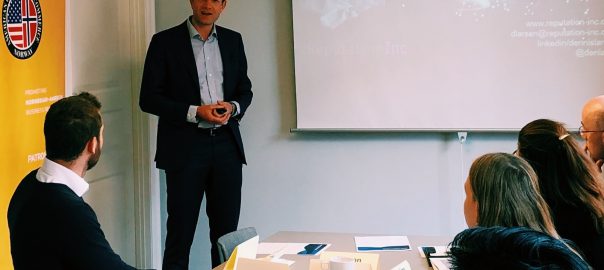
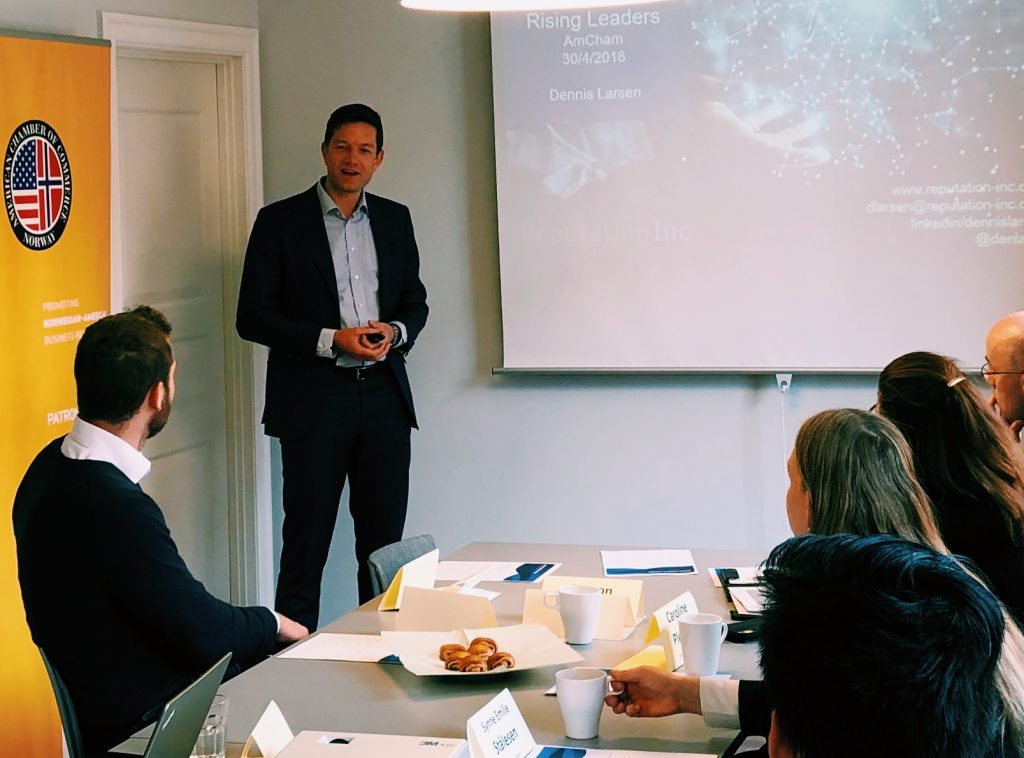
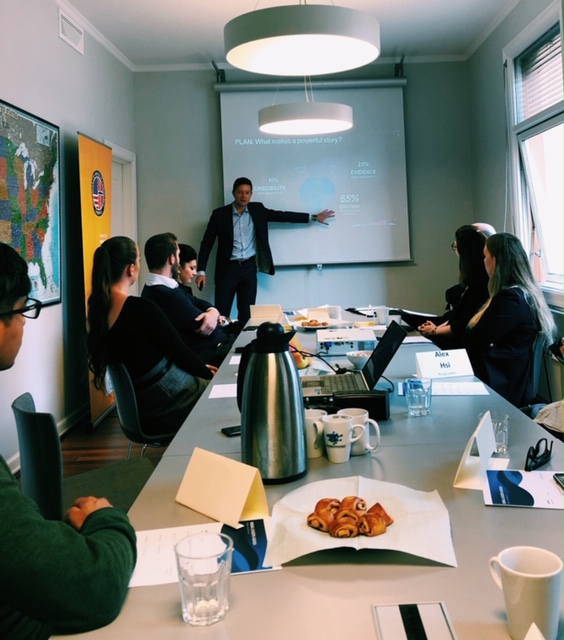
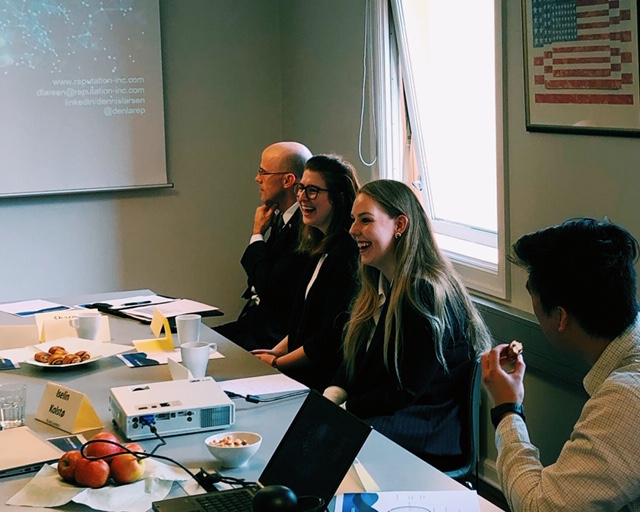
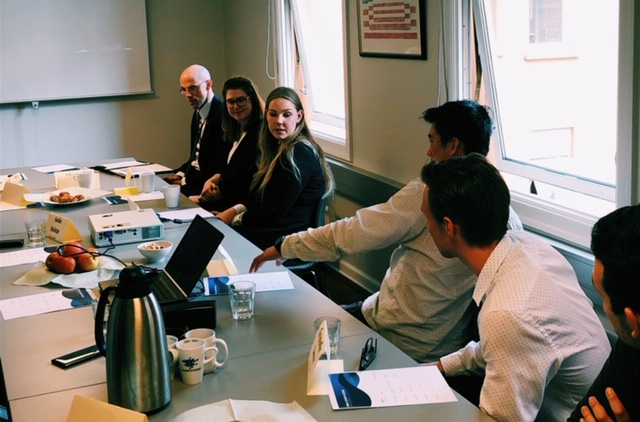
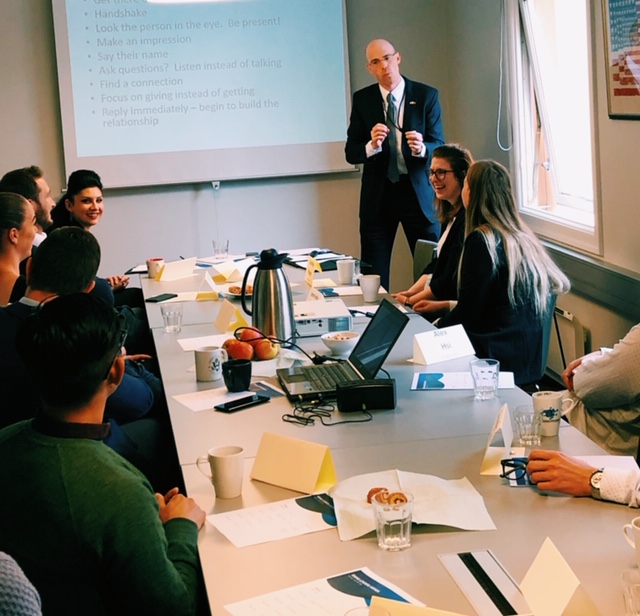
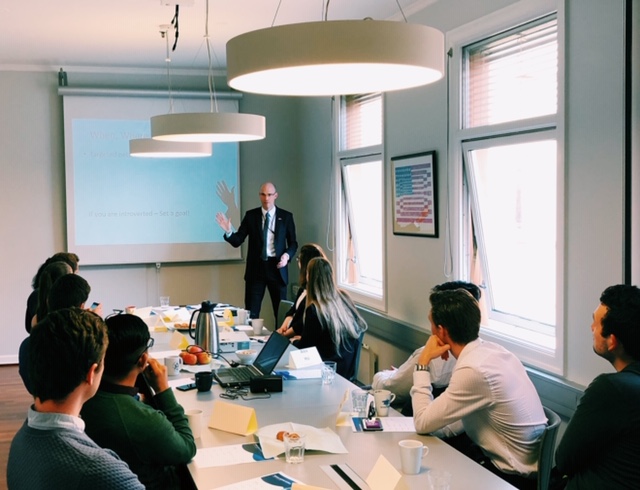
The Q2 edition of Rising Leaders focused on communication, with ReputationInc’s Dennis Larsen and the US Embassy’s Patrick Martino leading participants through a highly engaging afternoon session at AmCham’s offices.

Larsen, ReputationInc Oslo’s Managing Partner, spoke with program participants about the critical relationship between leadership and communication, highlighting the role of storytelling in connecting with target audiences. Martino then took participants through a crash course in international networking, drawing on over a decade of experience as a US diplomat.

Speaker Profile

Dennis Larsen – ReputationInc

Dennis has been a consultant to ReputationInc for more than a decade and is Managing Partner of ReputationInc Oslo. He is based in Oslo and London and serves clients internationally.

With an MSc in economics and MBA in Corporate Communications (with honours), Dennis’ approach to consulting is strongly rooted in science. He has been involved in academic and client based research on corporate reputation, corporate responsibility and financial communications, leading to publications and conference presentations.

Dennis helps clients enhance business performance through powerful diagnostics based on insight gained from primary and secondary research. He works across the four main areas of our offer and is keen to continue learning from every unique client situation and partnership.

When not immersed in reputation management consulting, he can be found skiing on remote Norwegian mountains in winter and marathon training in Oslo’s forests and London parks the rest of the year.

Leadership, Communication, and Storytelling in a Global Economy

Through a creative, engaging, and inspiring presentation, Larsen used the experiences of the program’s participants to underline why it is essential in today’s business world to be a skilled communicator.

“You can’t be a good leader if you’re not a good communicator,” he noted.

Program participants then described what kind of leader they wanted to become, which launched into an interesting discussion on what truly defines a good leader.

According to Larsen, the diversity of viewpoints in the room highlighted an important point – people perceive leaders in different ways. As a leader, it is vital that you understand these different perspectives, tailoring your approach to ensure that employees are engaged, motivated, and productive.

“As a leader, you’re in the human energy business!” he proclaimed.

The presentation then focused on examples of companies that took innovative approaches to fix internal communication issues, improving productivity and enhancing bottom lines along the way. Larsen highlighted leaders that understood that innovation had to begin with them, telling the story of an executive who decided to spend lunch with a different group of employees every day to better understand the issues they faced and how to engage them.

A critical component of such efforts, Larsen added, is the art of storytelling.


“Know your audience, plan your content, and deliver it,” he noted, before going on to show participants videos of different corporate leaders using storytelling to engage audiences and increase brand awareness successfully.

To close, Larsen focused on interpersonal communication, giving excellent tips on how young people can build stronger relationships as they progress in their careers, making the important point that in today’s digital world, one should never underestimate the power of a simple phone call.

“Don’t hide behind emails – call people up!” Larsen exclaimed.

“As a leader, you’re in the human energy business!”

Dennis Larsen

Managing Partner – ReputationInc

Speaker Profile

Patrick Martino – U.S. Embassy in Norway

Patrick Martino has been the Environmental, Science, Technology, and Health Officer at the U.S. Embassy in Oslo since May of 2017.  He has a broad portfolio covering environmental and scientific policies, including the Arctic.  

Mr. Martino previously served as a staff assistant in Washington at the State Department in the Bureau of Political and Military Affairs and as a desk officer covering Denmark in the Office of Nordic and Baltic Affairs.  He has also served in Helsinki, Finland and twice in Guangzhou, China.  Mr. Martino joined the U.S. Foreign Service in 2008. 

 Originally from Wisconsin, Mr. Martino graduated in 2000 from the University of Wisconsin – Madison with degrees in finance and economics.  He speaks Norwegian, Mandarin Chinese, and some Finnish. 

Networking Internationally – a Diplomat’s Perspective

Having worked for the State Department for over a decade, Patrick Martino shared how he cultivated a personal networking approach that takes cultural diversity into account, highlighting experiences in countries ranging from China to Norway.

Noting that over seventy percent of jobs are initiated through networking, Martino implored participants not to be afraid when presented with the opportunity to engage senior individuals, a point he made with a particularly relevant piece of advice he once received from a colleague.

“No matter what, always be confident that you have something important to offer!”

To conclude, Martino stressed the importance of maintaining relationships, noting, “It’s not always who you know, it’s who knows you.” He encouraged participants to find creative ways of engaging people, highlighting a variety of techniques he himself had found useful in his career.

“Focus on giving instead of getting. If they’re an expert in a particular field, send them an interesting, topical news article you saw. Send cards, reach out on social media – do the little things.”

About Rising Leaders

Rising Leaders is an initiative of the US Embassy and AmCham to provide access for young, up-and-coming leaders from diverse backgrounds to high-level representatives of the established business community. AmCham Managing Director Jason Turflinger and US Ambassador Kenneth Braithwaite officially inaugurated the program in April of this year.

The 23 program participants — consisting of 11 women and 12 men between the ages of 22 to 32—have demonstrated leadership, entrepreneurial, and/or business excellence in their educational pursuits and careers thus far. Participants engage business leaders, learn about AmCham member companies and gain business and leadership skills.

For more information about the program or to learn how your organization can get involved, please contact tb@amcham.no.

Pressemelding: Yara og IBM samarbeider om fremtidens landbruk

Oslo, Norge og Armonk, N.Y., 26. april, 2019: Yara International (OSE: YAR), et ledende globalt gjødselselskap, og IBM (NYSE: IBM), kunngjorde i dag en avtale om å bygge en global digital landbruksplattform, og å tilby helhetlige digitale tjenester og agronomisk rådgivning.

De to selskapene vil sammen bidra til å øke den globale matproduksjonen ved å trekke på sine komplementære evner: Yaras agronomiske kunnskap med over 800 agronomer på bakken og mer enn hundre års erfaring, og IBMs digitale plattformer, tjenester og kompetanse innen kunstig intelligens (AI) og dataanalyse.

«Vårt samarbeid dreier seg om å gjøre en reell forskjell i landbruket. For å kunne brødfø en voksende befolkning på en ansvarlig måte, er det avgjørende at bønder øker matproduksjonen på eksisterende jordbruksområder, slik at man unngår avskoging. Yara og IBM skal utvikle digitale løsninger som gir store og små bønder muligheten til å øke avlinger, kvalitet og inntekter på en bærekraftig måte,» sier Terje Knutsen, Konserndirektør for Salg og Markedsføring i Yara.

Den felles globale digitale landbruksplattformen vil anvende kunstig intelligens, maskinlæring og datainnsamling for å gi ny innsikt til bøndene. Den digitale plattformen vil være tilgjengelig over hele verden med en ambisjon om å dekke 100 millioner hektar jordbruksareal – noe som tilsvarer to ganger størrelsen på Spania eller nær 7 prosent av alle jordbruksarealer i hele verden*, inkludert millioner av småbruk.

«Ettersom etterspørselen etter mat stiger i takt med befolkningsøkningen i verden, vil den digitale landbruksplattformen spille en viktig rolle for å øke verdens avlinger på en bærekraftig måte. IBMs kapasitet og ekspertise innenfor AI, big data og blokkjede-teknologi, sammen med Yaras agronomiske kunnskap, digitale innovasjonskraft og globale erfaring innenfor landbruk, er en perfekt kombinasjon i partnerskapet vårt,» sier Luq Niazi, Global Managing Director for Consumer Industries i IBM.

Som et første skritt vil Yara og IBM etablere felles innovasjonsgrupper i digitale hubs i Europa, Singapore, USA og Brasil. Teamene skal samarbeide tett med IBM-forskere for å utvikle nye tjenester, for eksempel innen visuell analyse og maskininnlæringsteknikker for å identifisere og sjekke avlinger. De første tjenestene er planlagt levert i slutten av 2019.

Flytter grensene for digitalt jordbruk

Partnerskapet mellom Yara/IBM vil ta for seg alle aspekter ved jordbruksoptimering. Et spesifikt samarbeidsområde vil være værdata. Evnen til å reagere på væromslag er avgjørende for landbruk. Ved å slå sammen analytisk innsikt fra IBMs Watson Studio, IBM PAIRS-teknologien, The Weather Company og andre tjenester, med Yaras kunnskap om avlinger og modellering, vil den felles plattformen ikke bare muliggjøre hyperlokaliserte værmeldinger, men også kunne gi anbefalinger i sanntid, skreddersydd for hver enkelt åker og avling.

Når den felles digitale landbruksplattformen utvides, vil gruppene utforske løsninger for å integrere plattformen med IBM Food Trust, IBMs blokkjedebaserte nettverk for aktører i hele matkjeden. Dette vil muliggjøre større sporbarhet og effektivitet, samt gi nye verktøy for å bekjempe matsvindel, redusere svinn og øke bærekraft. Det vil knytte enkeltgårder sammen med hele matkjeden, og skape en helhetlig tilnærming til matproduksjon fra gård til tallerken.

Kontrakten ble inngått i april 2019.

* Verdensbanken, FAO.

Klikk HER for å lese hele pressemeldingen.
Press Release: TechnipFMC Awarded a Significant Integrated EPCI (iEPCI™) Contract for the ConocoPhillips TOR II Development

LONDON & PARIS & HOUSTON–(BUSINESS WIRE)– TechnipFMC (Paris:FTI) (NYSE:FTI) has been awarded a significant(1) integrated Engineering, Procurement, Construction and Installation (iEPCI™) contract from ConocoPhillips for the TOR II development, located in the Norwegian sector of the North Sea at a water depth of 80 meters.

This contract covers the delivery and installation of a subsea production system including installation of umbilical, rigid flowlines and associated subsea equipment.

Arnaud Pieton, President Subsea at TechnipFMC, commented: “This is the first iEPCI™ award by ConocoPhillips. Through early engagement and collaboration, with ConocoPhillips we engineered an integrated subsea solution enabling first oil sooner than with a traditional project execution. We have partnered with ConocoPhillips in the Ekofisk area on several projects and are honored that ConocoPhillips is expanding its scope with us, embracing our innovative and comprehensive approach”.

(1) For TechnipFMC, a “significant” contract ranges between $75 million and $250 million.

Read entire press release HERE.

Reuters: Norway’s wealth fund extends ownership of New York real estate

Norway’s sovereign wealth fund will pay about $98 million dollars to extend the term of its ownership in a portfolio of New York properties and to acquire a few new, the fund said on Wednesday.

“The partnership between Norges Bank Investment Management (NBIM), Trinity Church Wall Street and Hines has extended the remaining 72-year ownership interest in the Hudson Square portfolio in New York City to a 99-year term,” it said in a statement.

Read entire article HERE.

DNV GL: Someone has to go first

As the world’s leader in marine battery solutions, Norway is working to become the first country to electrify coastal transportation. And while there is still a long road ahead, Norway has a genuine advantage: A network of stakeholders working together to make it happen.

Increasing public concerns about the environment have led to a growing sense of urgency for Norway’s government and industry to act to slow climate change and improve air quality along its 2,650 km coastline. And with Norwegian domestic shipping contributing about nine per cent of Norway’s total carbon dioxide (CO2) emissions, 34 per cent of its nitrogen oxide (NOX) emissions and 25 per cent of its sulphur oxide (SOX) emissions, shipping has been identified as a key part of the clean air challenge.

Read entire article HERE.

MAREX: Nordic Countries Call for Ocean Plastic Treaty

Nordic governments have become the first in the world to formally call for a global treaty to tackle ocean plastic.

The call was made at a gathering of the environment ministers of Denmark, Finland, Iceland, Norway and Sweden at the Nordic Council in Reykjavik, Iceland. 

In the declaration, the ministers for the environment are pushing for a global agreement on plastic. The declaration, which has been sent to E.U. governing bodies, UNEP, the G7 and the G20, also asks the Nordic Council of Ministers to prepare a study to consider which specific elements should be included in a global agreement to combat microplastics and plastic waste in the marine environment.

Read entire article HERE.