All posts by admin

3M’s new granules for shingles help curb air pollution

3M Co. has a new product to fight air pollution, and it’s not a filter or industrial monitor. It’s a granule used in roof shingles.

When the granules are exposed to ultraviolet sunlight, “radicals” are generated that then transform nitrogen oxide into a substance that washes away with rain instead of polluting the air, officials said.

The product falls under 3M’s industrial mineral products unit and is aimed for use on residential homes. Commercial buildings for many years have had solutions such as solar-reflective granules and “green roofs,” which grow grass or gardens on top of buildings to help with the environment.

Solutions for the residential side of the business have not been nearly as robust, 3M said.

The company is marketing its new product as residential asphalt shingles, which cover about 80 percent of U.S. home roofs.

The new smog-reducing “roofing granules are a first for residential asphalt shingles,” said Frank Klink, 3M senior laboratory manager. “This smart solution for pollution mitigation can help communities toward their [nitrogen oxide] emission reduction efforts.”

The new product adds to 3M’s roofing might.

The company, which started making granules in the 1930s, is now one of the largest roof materials suppliers in the country with customers such as Owens Corning, Malarkey Roofing, Atlas Roofing and CertainTeed. Over the years, 3M has developed products with environmentally friendly elements such as heat reflective granules for “cool roofs” and coatings that fight roof algae.

Gayle Schueller, 3M’s chief sustainability officer, expects demand for the smog-reducing granules will grow as cities continue to grow and environmental concerns continue to be front of mind.

“We expect there will be a lot of interest in this,” she said.

For example, Los Angeles recently mandated all new home roofs be made with products that help the environment.

In June, Oregon-based Malarkey Roofing Products became the first shingle maker to blend and adhere 3M’s anti-smog granules onto its shingles.

Every shingle leaving Malarkey’s Los Angeles factory is now made with the new product. Malarkey’s shingle plants in Portland, Ore., and Oklahoma City will follow soon. The company started in Los Angeles because of the new mandates.

Malarkey CEO Jim Fagan expects his new shingles will be popular elsewhere, too. Salt Lake City, Phoenix, San Antonio, and Austin, Texas, are all dealing with smog-related problems.

Ambassador Aas: World Must Strengthen, Not Abandon, Multilateral Trading System

This month, the World Trade Organization (WTO) is hosting its annual Public Forum, a three-day marathon of open discussion on the latest developments in global trade. As many as 1,500 participants from governments, civil society, business and academia will explore ways to strengthen the rules-based system that has guided international trade for more than 70 years.

The topic this year, Trade 2030, could hardly be more timely. Issues such as sustainability, technology and inclusive growth will be key elements in shaping the global trading system for the 21st century. But the discussions in Geneva take place against a backdrop of rising trade tensions. The multilateral trading system is under pressure, and the challenges we face cannot be taken lightly. Underlying issues such as the rights and obligations of emerging economies need to be addressed, as do more specific issues such as transparency, subsidies, state-owned enterprises and technology transfer.

In the pre-World War II years, protectionism and economic depression shaped the world economy. In the years since, a liberal, rules-based multilateral trading system has fostered growth around the globe. Tensions in the multilateral trading system are bad news for billions of people throughout the world. It’s also bad for business, especially for small- and medium-size companies that cannot risk trading or investing in an unpredictable business climate. And it’s particularly damaging to the poorest countries.

The multilateral trading system is a remarkable triumph for international cooperation. It is a result of countless small steps and careful compromise. What seems unlikely today may be tomorrow’s triumph.

Safeguarding and strengthening that system, which has ushered in economic growth and other benefits throughout the world, should therefore be our top priority.

The Norwegian government is among those that have recently voiced concern over the state of world trade. We see a danger of increased instability in the world economy that could slow global growth. However, it is my personal experience that in trade policy — negotiations in particular — patience and trust are decisive factors for success. Early in my career, I was for some time part of the Norwegian negotiating team in the Uruguay Round. Long meetings, often running into the early hours, yielded results in the end.

As a trading nation, Norway prefers agreed-upon rules and predictability. That is why we put so much effort into finding solutions. We are fully aware of the need to address underlying concerns. However, we don’t believe that protectionism is a good answer. And we don’t want to gamble with what works in order to fix what doesn’t. The challenges are global; solutions should be multilateral.

In my opinion, it’s about time for the entire WTO membership to reflect on the root causes of the tensions in the trading system. How each of us responds will have an impact on our common good.

The principles of nondiscrimination, bound commitments and a rules-based system of dispute resolution are timeless. But trade in 2030 must be more sustainable and more inclusive. Let’s build on 70 years of dialogue between governments on the interface between individual countries’ political choices and the global common interest. Through shared norms, rules, regulations and dispute settlement procedures, member states seek to ensure that the global economy is based on international cooperation and an open, rules-based trade policy.

Norway will continue to work toward this goal, pushing for reforms and multilateral solutions, so that the multilateral trading system can continue to benefit us all.

Norway Open for Business: Attracting Foreign Investors

Norway is a small and open economy dependent upon foreign direct investments. How can Norwegian companies promote their strengths to enhance attractiveness internationally? How can companies ensure that they are noticed by potential partners or larger firms? And how can Norwegian companies attract the talent and competencies required to compete internationally?

Attracting Foreign Investors

Having focused upon sound policies to attract businesses to Norway in our 2018-19 Membership Guide, AmCham sat down with M&A experts at Thunderbird School of Global Management and talent management specialist Mercer to explore how companies can grow and strengthen through mergers, collaboration and acquisitions.

People

“At Thunderbird, we believe small and/or entrepreneurial firms need the three P’s to be noticed by larger firms or potential partners: Presentation, Prediction and People. Charts and graphs, though, aren’t enough to attract a larger firm or potential acquirer.”

While we may have a powerful presentation with solid predictions of our growth and value, investors and partners always look at a start-up or small firm’s people.”

“Thus, what kinds of talent you have – from the most junior to the most senior – is critical. In fact, many potential partners will often thoroughly review the biographies of a firm’s leaders long before reviewing financial projections.”

“Acquirers invest in a firm’s people – so how you train, develop, and lead your people is a critical component of success in the entrepreneurial space,” Thunderbird’s M&A specialists Henry Zinglersen and Paul W. Thaurman explain.

Per Myklestu, CEO of Mercer Norway, agrees and argues that, based on those facts, Norwegian companies are already at forefront of attracting international investments.

“Globally, Norway is associated with a high-cost of living. Although correct, when looking at how Norwegian companies compensate their employees, we experience that the higher you go within a company’s hierarchy, the cheaper the employee, compared to international wage structures. Hence, executives, leaders and highly educated employees are comparatively less expensive in Norway.

“Consequently, this means that high-competence industries and companies have substantially better terms in Norway, which should be a motivating factor for large companies looking to expand their portfolios,” Myklestu explains.

Innovation Friendly

While competent employees are a key component to generating growth, Myklestu believes that the structural model of the Norwegian company is a genuine advantage to stimulating innovation, collaboration and development.

“In the Nordics, and particularly in Norway, the flat company structure helps the development of new ideas. The road to the top is shorter, which means that it is easier for employees to get their ideas heard.”

“Additionally, it is customary for Norwegian employees to have significant freedom and responsibility, where the employer creates an environment enabling their employees to grow and develop. This further promotes innovative ideas, and we have seen several examples of niche companies taking an established idea and existing skills into a new market,” he says.

Attracting Foreign Investors

According to Zinglersen, this is a factor that should help to attract interest from larger, international companies.

Acquiring firms want to see a management team that can take responsibility and ownership, while building a solid culture of collaboration with employees across the organization. They want to be confident in the projections and predictions that a management team creates, and to be persuaded to partner or invest based on how the expanding firm presents its value proposition,” he explains.

A Laboratory for Emerging Business Ideas

It is firmly documented that Norway is well ahead in terms of digitalization and productivity. In fact, Time Magazine has ranked Norway the third most productive country in the world.

According to Myklestu, these factors could enable Norway to use existing world-leading expertise in natural resources related fields like aquaculture and offshore to define new industries for future growth.

“We should highlight how having a daughter company in Norway could be utilized as a test lab for new ideas and digital implementations. We are a small country, which makes it easier to conduct experiments here, before potentially implementing them globally.”

“This will further generate growth in industries in which we have previously been successful. In return, this will boost start-ups and entrepreneurial initiatives, as well as allow new, exciting and profitable industries – such as the healthcare industry – to grow,” Myklestu says.

While Thaurman emphasizes the importance of investing in direct marketing to profile Norway’s industry-specific expertise and capabilities, he says it is equally important to offer incentives for outside firms to invest in the Norwegian market.

“Promotion of favorable tax treatments, labor portability and access are important factors, alongside creation of incubators, where joint ventures — especially those involving cross-border alliances – can experiment with new ideas and explore new business areas and markets with open access to senior business leaders and market testing capabilities.”

“Thus, by attracting foreign investors with direct appeals and then allowing them to access local labor markets, test ideas using local laboratories and consumer bases, and subsequently partner, merge, or acquire local firms when products and services show promise, Norway can be seen as not only a great investment but also a great laboratory in which to test new, emerging business ideas,” Thaurman says.

Attracting Foreign Investors

As a final caution, Zinglersen points to the importance of getting the collaboration or integration with foreign investors right from the beginning.

“The flat organizational structure and strong ownership amongst Norwegian leaders and employees often causes significant challenges if not managed well. Mergers, acquisitions, and joint ventures with foreign investors coming into Norway too often fail to deliver their expected value, due to poor integration of people, team cultures, and organizations.”

Norway Open for Business: Attracting Foreign Investors

Norway is a small and open economy dependent upon foreign direct investments. How can Norwegian companies promote their strengths to enhance attractiveness internationally? How can companies ensure that they are noticed by potential partners or larger firms? And how can Norwegian companies attract the talent and competencies required to compete internationally?

Having focused upon sound policies to attract businesses to Norway in our 2018-19 Membership Guide, AmCham sat down with M&A experts at Thunderbird School of Global Management and talent management specialist Mercer to explore how companies can grow and strengthen through mergers, collaboration and acquisitions.

People

“At Thunderbird, we believe small and/or entrepreneurial firms need the three P’s to be noticed by larger firms or potential partners: Presentation, Prediction and People. Charts and graphs, though, aren’t enough to attract a larger firm or potential acquirer.”

While we may have a powerful presentation with solid predictions of our growth and value, investors and partners always look at a start-up or small firm’s people.”

“Thus, what kinds of talent you have – from the most junior to the most senior – is critical. In fact, many potential partners will often thoroughly review the biographies of a firm’s leaders long before reviewing financial projections.”

Attracting Foreign Investors

Henry Zinglersen, Thunderbird

“Acquirers invest in a firm’s people – so how you train, develop, and lead your people is a critical component of success in the entrepreneurial space,” Thunderbird’s M&A specialists Henry Zinglersen and Paul W. Thaurman explain.

Per Myklestu, CEO of Mercer Norway, agrees and argues that, based on those facts, Norwegian companies are already at forefront of attracting international investments.

“Globally, Norway is associated with a high-cost of living. Although correct, when looking at how Norwegian companies compensate their employees, we experience that the higher you go within a company’s hierarchy, the cheaper the employee, compared to international wage structures. Hence, executives, leaders and highly educated employees are comparatively less expensive in Norway.

“Consequently, this means that high-competence industries and companies have substantially better terms in Norway, which should be a motivating factor for large companies looking to expand their portfolios,” Myklestu explains.

Innovation Friendly

While competent employees are a key component to generating growth, Myklestu believes that the structural model of the Norwegian company is a genuine advantage to stimulating innovation, collaboration and development.

“In the Nordics, and particularly in Norway, the flat company structure helps the development of new ideas. The road to the top is shorter, which means that it is easier for employees to get their ideas heard.”

Attracting Foreign Investors

Paul W. Thaurman, Thunderbird

“Additionally, it is customary for Norwegian employees to have significant freedom and responsibility, where the employer creates an environment enabling their employees to grow and develop. This further promotes innovative ideas, and we have seen several examples of niche companies taking an established idea and existing skills into a new market,” he says.

According to Zinglersen, this is a factor that should help to attract interest from larger, international companies.

Acquiring firms want to see a management team that can take responsibility and ownership, while building a solid culture of collaboration with employees across the organization. They want to be confident in the projections and predictions that a management team creates, and to be persuaded to partner or invest based on how the expanding firm presents its value proposition,” he explains.

A Laboratory for Emerging Business Ideas

It is firmly documented that Norway is well ahead in terms of digitalization and productivity. In fact, Time Magazine has ranked Norway the third most productive country in the world.

According to Myklestu, these factors could enable Norway to use existing world-leading expertise in natural resources related fields like aquaculture and offshore to define new industries for future growth.

Attracting Foreign Investors

Per Myklestu, Mercer Norway

“We should highlight how having a daughter company in Norway could be utilized as a test lab for new ideas and digital implementations. We are a small country, which makes it easier to conduct experiments here, before potentially implementing them globally.”

“This will further generate growth in industries in which we have previously been successful. In return, this will boost start-ups and entrepreneurial initiatives, as well as allow new, exciting and profitable industries – such as the healthcare industry – to grow,” Myklestu says.

While Thaurman emphasizes the importance of investing in direct marketing to profile Norway’s industry-specific expertise and capabilities, he says it is equally important to offer incentives for outside firms to invest in the Norwegian market.

“Promotion of favorable tax treatments, labor portability and access are important factors, alongside creation of incubators, where joint ventures — especially those involving cross-border alliances – can experiment with new ideas and explore new business areas and markets with open access to senior business leaders and market testing capabilities.”

“Thus, by attracting foreign investors with direct appeals and then allowing them to access local labor markets, test ideas using local laboratories and consumer bases, and subsequently partner, merge, or acquire local firms when products and services show promise, Norway can be seen as not only a great investment but also a great laboratory in which to test new, emerging business ideas,” Thaurman says.

As a final caution, Zinglersen points to the importance of getting the collaboration or integration with foreign investors right from the beginning.

“The flat organizational structure and strong ownership amongst Norwegian leaders and employees often causes significant challenges if not managed well. Mergers, acquisitions, and joint ventures with foreign investors coming into Norway too often fail to deliver their expected value, due to poor integration of people, team cultures, and organizations.”

AmCham Digitalization Forum – September 2018

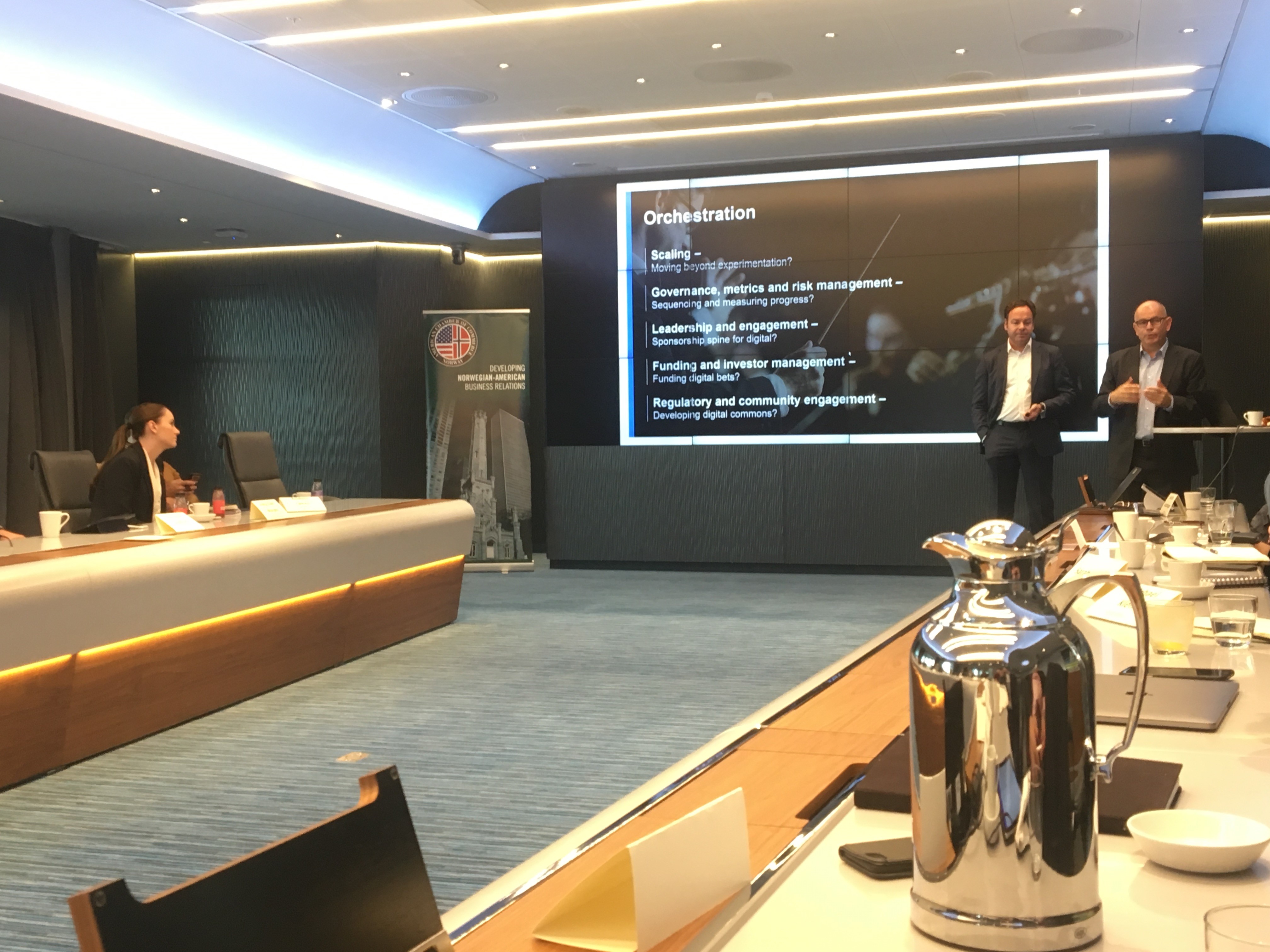
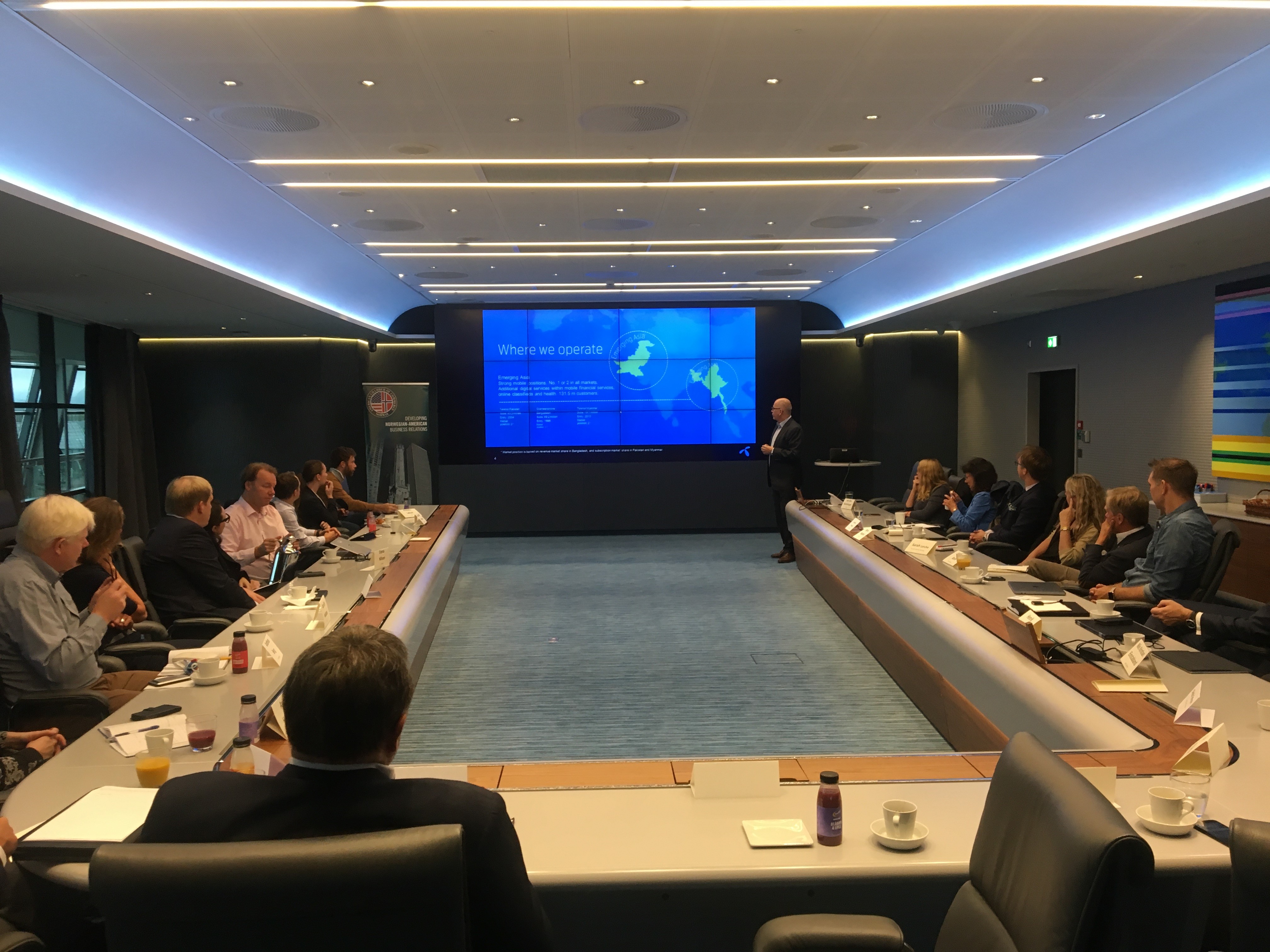
“We sell products that are personalized. When someone in Myanmar watches YouTube on their phone and runs out of data, we need to know that and be able to offer them an immediate and easy way of upgrading their plan,” Telenor’s VP and Head of Future Customer Service Programs, Geir Olav Guttuhaugen, said as they hosted AmCham’s Digitalization forum.

Highlighted were his company’s lessons learned within Digital Ambition & the Role of Simplification.

Taking 25 invited executives through some of Telenor’s most complex digital change processes, Guttuhaugen explained that fundamental to each undertaking is some level of customer experience evaluation.

“It is difficult to integrate all services for improved customer service. We have to focus on what customers are saying to truly improve their experience, and then ensure that top management – along with our best people – are involved to support the implementation.”

“At a certain point in the digitalization process, you get to a stage were significant investment is needed to drive forward momentum and to make the next leap. At that point, it is important to avoid a cost-only focus and trust your customers,” Guttuhaugen further explained.

Customers Driving Digital Transformation

“Most digital transformation projects fail to deliver. When it comes to digital projects, we have determined that merely 1% are deemed successful or exceeded set expectations,” Bain & Co. Partner Henrik Poppe showed during the morning’s second presentation.

Having collaborated in Telenor’s transformation processes, Poppe agreed that customer feedback – often in the form of Net Promoter Scores (NPS) – should form the platform upon which to develop digital change.

Digitalization Forum – September

“If you look at some of the world’s largest companies, like Uber, Domino’s Pizza or Netflix, they are offering customers something that was already available, only now it is in a different format more customized to their customers’ needs,” he explained.

“Data, and the ability to measure and analyze it, is critical to enabling risk-taking and determining who will capture value chain control points.”

Collaboration

Moderated by Jennifer Vessels, CEO of Silicon Valley-based Next Step, the subsequent group discussion highlighted the importance of larger companies collaborating with – and even spawning – smaller companies to gain fresh perspectives.

“It is important to work with start-ups without cannibalizing one’s own business model. Through collaboration, you think critically about current company processes, gain access to new data, and test new products, thereby learning along the way,” said a ranking participant.

“It is like the smaller boats surrounding a large ship. The speedboats can get somewhere faster, but the tanker is going to be more powerful,” another participant noted.

Simplification Before Digitalization

Regardless of internally or externally-oriented digital change plans, several participants have experienced that current processes need to be boiled down to their core components before success can be attained.

Digitalization Forum – September

Vessels noted that successful directors often guide the direction of such long-term initiatives, freely admitting that they don’t know precisely how the organization will finally emerge as a truly digital actor.

“Directors need to ask themselves ‘what the market – and our company – will look like 2-3 years from now if we stay the same?’”

“Get started, and then the process will direct the solution,” noted an experienced director.

Another director participant noted finally that “some of our customers and partners consider themselves digital, but…”

Scanship wins contract for Atlantic Sapphire

Scanship Holding has signed a contract with Billund Aquakulturservice for the delivery of a sludge handling system to Miami-based land farm Atlantic Sapphire.

The facility in Homestead will be built in several steps, and the contract includes supplying what it calls its “environmental protection and circular economy” technology for the first step.

“With this milestone contract, we are now in all three segments of a growing aquaculture market for smolt, seabased closed cage and landbased farms”, says CEO Henrik Badin in a statement.

The company provides advanced technologies for processing waste and purifying wastewater. The contract, inked through subsidiary Scanship, represents an expansion of Scanship Holding’s aquaculture business into overseas markets.

In May, the company won a contract to build a land-based freshwater facility for Scottish Sea Farms, which is expected to be completed in November.

Atlantic Sapphire, is a Norwegian outfit founded by Norwegian salmon entrepreneurs Johan Andreassen and Bjorn-Vegard Lovik which aims to eventually produce 90,000 tonnes of salmon per year near Miami, Florida.

The world’s largest sovereign wealth fund is getting stricter on the companies it invests in

Norway’s $1 trillion sovereign wealth fund has said that it expects businesses to “manage the challenges and opportunities related to sustainable uses of the ocean.”

Norges Bank Investment Management (NBIM), which manages Norway’s sovereign wealth fund on behalf of the finance ministry, said Wednesday that companies should, among other things: integrate ocean sustainability into strategy; integrate material ocean-related risks into risk management; and act responsibly and transparently on ocean-related governance.

Businesses should also, NBIM said, “disclose how ocean sustainability forms part of their strategies, policies and commitments.”

The issue of ocean pollution is a serious one. To give just one example, more than 700 species “encounter marine litter in the environment” according to the University of Plymouth’s International Marine Litter Research Unit.

“The ocean is a vital part of the biosphere and an important part of the global economy,” Yngve Slyngstad, NBIM’s CEO, said in a statement on Wednesday. “We expect companies to manage the challenges and opportunities related to sustainable use of the ocean,” Slyngstad added.

Wednesday also saw NBIM publish a note relating to how it, as a responsible investor, could support sustainable development and help “fulfil the UN Sustainable Development Goals (SDGs).”

The UN’s goals address a host of subjects, including the environment, poverty, climate change and gender equality.

“The fund’s investments in more than 9,000 companies in 72 countries contribute directly and indirectly to a number of the SDGs,” Slyngstad said. “Our most important contribution is to strengthen governance, improve performance and promote sustainable business practices,” he added.

The fund, Slyngstad said, invested in developing markets and businesses that were coming up with solutions for a “more environmentally friendly economy.” It also divested from companies that had “unsustainable business models.”

Norway 3rd in “Most Productive Countries in the World” Ranking

With a new law barring work e-mail after hours, the French have honored a truth long recognized by economists: working longer hours doesn’t necessarily result in increased productivity.

Mexico—the least productive of the 38 countries listed in 2015 data from the Organization for Economic Cooperation and Development (OECD)—has the world’s longest average work week at 41.2 hours (including full-time and part-time workers). At the other end of the spectrum, Luxembourg, the most productive country, has an average workweek of just 29 hours.

The United States ranks fifth, according to the OECD, contributing $68.30 to the country’s GDP per hour worked, countering claims that Americans are the most productive workers in the world. America put in more hours—33.6 per week on average—than all four of the European countries with higher productivity rankings.

Most Productive Countries, 2015

RANK COUNTRY GDP PER HOUR WORKED EMPLOYED POPULATION GDP (USD) AVERAGE WORK WEEK (HRS)
1 Luxembourg $ 93.4 405,600 $57b 29
2 Ireland $ 87.3 1,989,400 $302b 33.5
3 Norway $ 81.3 2,753,000 $318b 27.3
4 Belgium $ 69.7 4,601,200 $498b 29.8
5 United States $ 68.3 151,000,000 $18,037b 33.6

BI blant de 100 beste på global FT-rangering

Handelshøyskolen BI oppnår en 87. plass med sin Master of Science in Business (Siviløkonomstudiet) på Financial Times’ rangering av verdens 100 beste Masters in Management-programmer i 2018.

Rangeringen er blant annet basert på kandidatenes lønns- og karriereutvikling etter endt studie, antall ansatte med doktorgrad, kvinneandel i styre, fagstab og blant studentene, samt en rekke kriterier som måler grad av internasjonalisering i organisasjonen, i utdanningen og blant studentene.

– Rangeringer som dette er verdifulle for oss og synliggjør BI internasjonalt. De er med på å avgjøre vår evne til å tiltrekke oss de beste fagressursene og de beste studentene, noe som igjen gjør at vi er attraktive som samarbeidspartner for næringsliv og andre utdanningsinstitusjoner, sier rektor ved Handelshøyskolen BI, Inge Jan Henjesand.

Årets rangering er utvidet med fem nye konkurrerende skoler.

– Samtidig som konkurransen om plassene på denne rangeringen øker, veier lønnsnivå og lønnsøkning forholdsvis tungt. Selv om vårt langsiktige mål er å klatre på denne listen, er det vanskelig å konkurrere på akkurat disse kriteriene sammenlignet med for eksempel England, Tyskland og Frankrike. Det gir oss derimot motivasjon for å fortsette den langsiktige innsatsen til hele organisasjonen. Med i overkant av ca. 15.000 handelshøyskoler verden over er det et kvalitetsstempel i seg selv å være på listen, sier Henjesand.

I 2017 ble BIs siviløkonomutdanning rangert på en 77. plass av totalt 95 skoler. I 2016 ble BIs programmet rangert på en 71. plass av totalt 90 rangerte skoler, og i 2015 havnet BI på en 73. plass blant henholdsvis 80 skoler.

– For våre studenter betyr dette at de gradueres fra en handelshøyskole som har høy anerkjennelse internasjonalt. Det er også en bekreftelse for virksomheter som rekrutterer våre kandidater, at de får den beste kompetansen når de rekrutterer fra BI, sier Janicke Rasmussen, Dean Master ved Handelshøyskolen BI.

Om rangeringen:

FT har 9 programrangeringer, og BI deltar i fem av disse: Masters in Finance, Masters in Management (BI er rangert med sitt siviløkonom-program), Executive Education – Open, Executive Education -Customised, Executive MBA og European Business School Rankings.